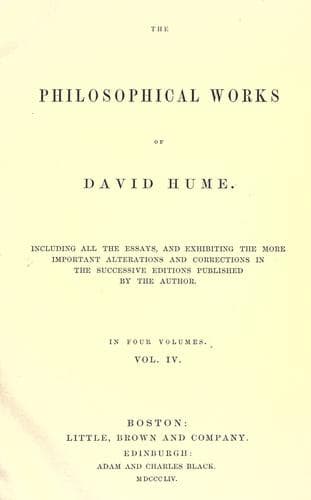
Philosophical Works, v. 1 (of 4): Including All the Essays, and Exhibiting the More Important Alterations and Corrections in the Successive Editions Published by the AuthorHume, David
PhilosophyPhilosophy
Philosophical Works, v. 1 (of 4): Including All the Essays, and Exhibiting the More Important Alterations and Corrections in the Successive Editions Published by the Author
Hume, David
Knowledge, Theory of; Philosophy, English -- 18th century
We have already seen the influence of the two first qualities of the
dye, viz. the _causes_, and the _number_, and _indifference_ of the
sides, and have learned how they give an impulse to the thought, and
divide that impulse into as many parts as there are units in the number
of sides. We must now consider the effects of the third particular,
viz. the _figures_ inscribed on each side. 'Tis evident, that where
several sides have the same figure inscribed on them, they must concur
in their influence on the mind, and must unite upon one image or idea
of a figure all those divided impulses, that were dispersed over the
several sides, upon which that figure is inscribed. Were the question
only what side will be turned up, these are all perfectly equal, and no
one could ever have any advantage above another. But as the question
is concerning the figure, and as the same figure is presented by more
than one side, 'tis evident that the impulses belonging to all these
sides must re-unite in that one figure, and become stronger and more
forcible by the union. Four sides are supposed in the present case
to have the same figure inscribed on them, and two to have another
figure. The impulses of the former are therefore superior to those of
the latter. But as the events are contrary, and 'tis impossible both
these figures can be turned up; the impulses likewise become contrary,
and the inferior destroys the superior, as far as its strength goes.
The vivacity of the idea is always proportionable to the degrees of the
impulse or tendency to the transition; and belief is the same with the
vivacity of the idea, according to the precedent doctrine.
SECTION XII.
OF THE PROBABILITY OF CAUSES.
What I have said concerning the probability of chances, can serve to
no other purpose than to assist us in explaining the probability of
causes; since 'tis commonly allowed by philosophers, that what the
vulgar call chance is nothing but a secret and concealed cause. That
species of probability, therefore, is what we must chiefly examine.
The probabilities of causes are of several kinds; but are all derived
from the same origin, viz. _the association of ideas to a present
impression_. As the habit which produces the association, arises from
the frequent conjunction of objects, it must arrive at its perfection
by degrees, and must acquire new force from each instance that falls
under our observation. The first instance has little or no force:
the second makes some addition to it: the third becomes still more
sensible; and 'tis by these slow steps that our judgment arrives at
a full assurance. But before it attains this pitch of perfection, it
passes through several inferior degrees, and in all of them is only to
be esteemed a presumption or probability. The gradation therefore from
probabilities to proofs is in many cases insensible; and the difference
betwixt these kinds of evidence is more easily perceived in the remote
degrees, than in the near and contiguous.
Public-domain text, read in full here on John Shaqi.
Reviews
Reviews
No reviews yet
Be the first to share your thoughts on this work.
Elsewhere in the archive
Join the Discussion
Join the discussion
Sign in to leave a comment or review.
Sign InorCreate an account