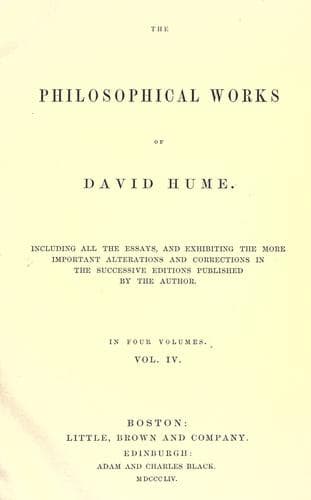
Philosophical Works, v. 1 (of 4): Including All the Essays, and Exhibiting the More Important Alterations and Corrections in the Successive Editions Published by the AuthorHume, David
PhilosophyPhilosophy
Philosophical Works, v. 1 (of 4): Including All the Essays, and Exhibiting the More Important Alterations and Corrections in the Successive Editions Published by the Author
Hume, David
Knowledge, Theory of; Philosophy, English -- 18th century
'Tis worthy of remark on this occasion, that though the species of
probability here explained be the first in order, and naturally takes
place before any entire proof can exist, yet no one, who is arrived
at the age of maturity, can any longer be acquainted with it. 'Tis
true, nothing is more common than for people of the most advanced
knowledge to have attained only an imperfect experience of many
particular events; which naturally produces only an imperfect habit
and transition: but then we must consider, that the mind, having
formed another observation concerning the connexion of causes and
effects, gives new force to its reasoning from that observation; and
by means of it can build an argument on one single experiment, when
duly prepared and examined. What we have found once to follow from any
object, we conclude will for ever follow from it; and if this maxim be
not always built upon as certain, 'tis not for want of a sufficient
number of experiments, but because we frequently meet with instances
to the contrary; which leads us to the second species of probability,
where there is a _contrariety_ in our experience and observation.
'Twould be very happy for men in the conduct of their lives and
actions, were the same objects always conjoined together, and we
had nothing to fear but the mistakes of our own judgment, without
having any reason to apprehend the uncertainty of nature. But as 'tis
frequently found, that one observation is contrary to another, and that
causes and effects follow not in the same order, of which we have had
experience, we are obliged to vary our reasoning on account of this
uncertainty, and take into consideration the contrariety of events. The
first question that occurs on this head, is concerning the nature and
causes of the contrariety.
Public-domain text, read in full here on John Shaqi.
Reviews
Reviews
No reviews yet
Be the first to share your thoughts on this work.
Elsewhere in the archive
Join the Discussion
Join the discussion
Sign in to leave a comment or review.
Sign InorCreate an account