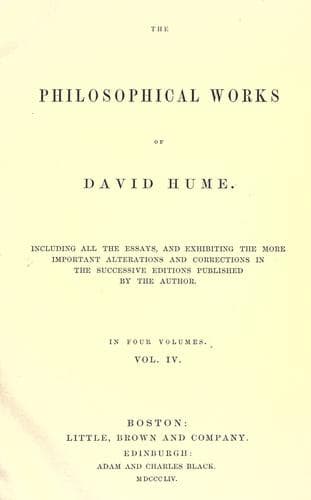
Philosophical Works, v. 1 (of 4): Including All the Essays, and Exhibiting the More Important Alterations and Corrections in the Successive Editions Published by the AuthorHume, David
PhilosophyPhilosophy
Philosophical Works, v. 1 (of 4): Including All the Essays, and Exhibiting the More Important Alterations and Corrections in the Successive Editions Published by the Author
Hume, David
Knowledge, Theory of; Philosophy, English -- 18th century
There is no doubt but this principle sometimes takes place, and
produces those inferences we draw from contrary phenomena; though I
am persuaded that, upon examination, we shall not find it to be the
principle that most commonly influences the mind in this species of
reasoning. When we follow only the habitual determination of the mind,
we make the transition without any reflection, and interpose not a
moment's delay betwixt the view of one object, and the belief of that
which is often found to attend it. As the custom depends not upon any
deliberation, it operates immediately, without allowing any time for
reflection. But this method of proceeding we have but few instances of
in our probable reasonings; and even fewer than in those, which are
derived from the uninterrupted conjunction of objects. In the former
species of reasoning we commonly take knowingly into consideration
the contrariety of past events; we compare the different sides of the
contrariety, and carefully weigh the experiments, which we have on each
side: whence we may conclude, that our reasonings of this kind arise
not _directly_ from the habit, but in an _oblique_ manner; which we
must now endeavour to explain.
'Tis evident, that when an object is attended with contrary effects,
we judge of them only by our past experience, and always consider
those as possible, which we have observed to follow from it. And as
past experience regulates our judgment concerning the possibility of
these effects, so it does that concerning their probability; and that
effect, which has been the most common, we always esteem the most
likely. Here then are two things to be considered, viz. the _reasons_
which determine us to make the past a standard for the future, and the
_manner_ how we extract a single judgment from a contrariety of past
events.
First we may observe, that the supposition, _that the future resembles
the past_, is not founded on arguments of any kind, but is derived
entirely from habit, by which we are determined to expect for the
future the same train of objects to which we have been accustomed. This
habit or determination to transfer the past to the future is full and
perfect; and consequently the first impulse of the imagination in this
species of reasoning is endowed with the same qualities.
But, _secondly_, when in considering past experiments we find them
of a contrary nature, this determination, though full and perfect in
itself, presents us with no steady object, but offers us a number of
disagreeing images in a certain order and proportion. The first impulse
therefore is here broke into pieces, and diffuses itself over all
those images, of which each partakes an equal share of that force and
vivacity that is derived from the impulse. Any of these past events
may again happen; and we judge, that when they do happen, they will be
mixed in the same proportion as in the past.
Public-domain text, read in full here on John Shaqi.
Reviews
Reviews
No reviews yet
Be the first to share your thoughts on this work.
Elsewhere in the archive
Join the Discussion
Join the discussion
Sign in to leave a comment or review.
Sign InorCreate an account