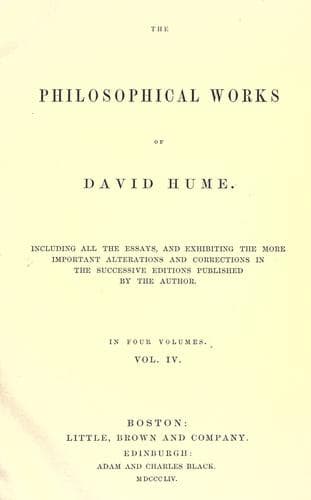
Philosophical Works, v. 1 (of 4): Including All the Essays, and Exhibiting the More Important Alterations and Corrections in the Successive Editions Published by the AuthorHume, David
PhilosophyPhilosophy
Philosophical Works, v. 1 (of 4): Including All the Essays, and Exhibiting the More Important Alterations and Corrections in the Successive Editions Published by the Author
Hume, David
Knowledge, Theory of; Philosophy, English -- 18th century
The vulgar, who take things according to their first appearance,
attribute the uncertainty of events to such an uncertainty in the
causes, as makes them often fail of their usual influence, though
they meet with no obstacle nor impediment in their operation. But
philosophers observing, that almost in every part of nature there is
contained a vast variety of springs and principles, which are hid,
by reason of their minuteness or remoteness, find that 'tis at least
possible the contrariety of events may not proceed from any contingency
in the cause, but from the secret operation of contrary causes. This
possibility is converted into certainty by farther observation, when
they remark, that upon an exact scrutiny, a contrariety of effects
always betrays a contrariety of causes, and proceeds from their mutual
hinderance and opposition. A peasant can give no better reason for
the stopping of any clock or watch than to say, that commonly it
does not go right: but an artisan easily perceives, that the same
force in the spring or pendulum has always the same influence on the
wheels; but fails of its usual effect, perhaps by reason of a grain of
dust, which puts a stop to the whole movement. From the observation
of several parallel instances, philosophers form a maxim, that the
connexion betwixt all causes and effects is equally necessary, and that
its seeming uncertainty in some instances proceeds from the secret
opposition of contrary causes.
But however philosophers and the vulgar may differ in their explication
of the contrariety of events, their inferences from it are always of
the same kind, and founded on the same principles. A contrariety of
events in the past may give us a kind of hesitating belief for the
future, after two several ways. First, by producing an imperfect habit
and transition from the present impression to the related idea. When
the conjunction of any two objects is frequent, without being entirely
constant, the mind is determined to pass from one object to the other;
but not with so entire a habit, as when the union is uninterrupted, and
all the instances we have ever met with are uniform and of a piece.
We find from common experience, in our actions as well as reasonings,
that a constant perseverance in any course of life produces a strong
inclination and tendency to continue for the future; though there
are habits of inferior degrees of force, proportioned to the inferior
degrees of steadiness and uniformity in our conduct.
Public-domain text, read in full here on John Shaqi.
Reviews
Reviews
No reviews yet
Be the first to share your thoughts on this work.
Elsewhere in the archive
Join the Discussion
Join the discussion
Sign in to leave a comment or review.
Sign InorCreate an account