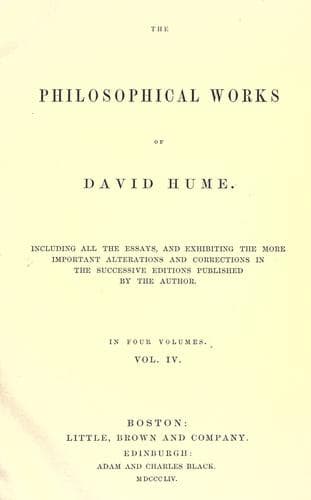
Philosophical Works, v. 1 (of 4): Including All the Essays, and Exhibiting the More Important Alterations and Corrections in the Successive Editions Published by the AuthorHume, David
PhilosophyPhilosophy
Philosophical Works, v. 1 (of 4): Including All the Essays, and Exhibiting the More Important Alterations and Corrections in the Successive Editions Published by the Author
Hume, David
Knowledge, Theory of; Philosophy, English -- 18th century
Here is almost the same argument in a different light. All our
reasonings concerning the probability of causes are founded on the
transferring of past to future. The transferring of any past experiment
to the future is sufficient to give us a view of the object; whether
that experiment be single or combined with others of the same kind;
whether it be entire, or opposed by others of a contrary kind. Suppose
then it acquires both these qualities of combination and opposition,
it loses not, upon that account, its former power of presenting a view
of the object, but only concurs with and opposes other experiments that
have a like influence. A question, therefore, may arise concerning the
manner both of the concurrence and opposition. As to the _concurrence_
there is only the choice left betwixt these two hypotheses. _First_,
that the view of the object, occasioned by the transference of each
past experiment, preserves itself entire, and only multiplies the
number of views. Or, _secondly_, that it runs into the other similar
and correspondent views, and gives them a superior degree of force and
vivacity. But that the first hypothesis is erroneous, is evident from
experience, which informs us, that the belief attending any reasoning
consists in one conclusion, not in a multitude of similar ones, which
would only distract the mind, and, in many cases, would be too numerous
to be comprehended distinctly by any finite capacity. It remains,
therefore, as the only reasonable opinion, that these similar views run
into each other and unite their forces; so as to produce a stronger and
clearer view than what arises from any one alone. This is the manner in
which past experiments concur when they are transferred to any future
event. As to the manner of their _opposition_,'tis evident that, as the
contrary views are incompatible with each other, and 'tis impossible
the object can at once exist conformable to both of them, their
influence becomes mutually destructive, and the mind is determined to
the superior only with that force which remains after subtracting the
inferior.
Public-domain text, read in full here on John Shaqi.
Reviews
Reviews
No reviews yet
Be the first to share your thoughts on this work.
Elsewhere in the archive
Join the Discussion
Join the discussion
Sign in to leave a comment or review.
Sign InorCreate an account