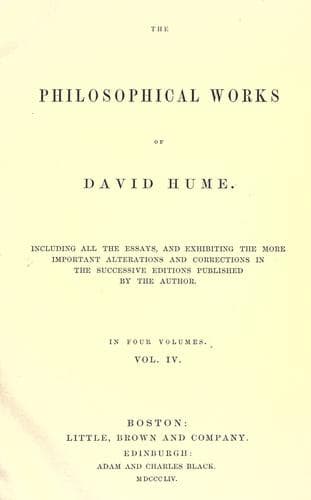
Philosophical Works, v. 1 (of 4): Including All the Essays, and Exhibiting the More Important Alterations and Corrections in the Successive Editions Published by the AuthorHume, David
PhilosophyPhilosophy
Philosophical Works, v. 1 (of 4): Including All the Essays, and Exhibiting the More Important Alterations and Corrections in the Successive Editions Published by the Author
Hume, David
Knowledge, Theory of; Philosophy, English -- 18th century
I am sensible how abstruse all this reasoning must appear to the
generality of readers, who, not being accustomed to such profound
reflections on the intellectual faculties of the mind, will be apt
to reject as chimerical whatever strikes not in with the common
received notions, and with the easiest and most obvious principles of
philosophy. And, no doubt, there are some pains required to enter into
these arguments; though perhaps very little are necessary to perceive
the imperfection of every vulgar hypothesis on this subject, and the
little light, which philosophy can yet afford us in such sublime and
such curious speculations. Let men be once fully persuaded of these
two principles, _that there is nothing in any object, considered in
itself, which can afford us a reason for drawing a conclusion beyond
it_; and, _that even after the observation of the frequent or constant
conjunction of objects, we have no reason to draw any inference
concerning any object beyond those of which we have had experience_;
I say, let men be once fully convinced of these two principles, and
this will throw them so loose from all common systems, that they
will make no difficulty of receiving any, which may appear the most
extraordinary. These principles we have found to be sufficiently
convincing, even with regard to our most certain reasonings from
causation: but I shall venture to affirm, that with regard to these
conjectural or probable reasonings they still acquire a new degree of
evidence.
_First_,'tis obvious that, in reasonings of this kind, 'tis not the
object presented to us, which, considered in itself, affords us any
reason to draw a conclusion concerning any other object or event. For
as this latter object is supposed uncertain, and as the uncertainty is
derived from a concealed contrariety of causes in the former, were any
of the causes placed in the known qualities of that object, they would
no longer be concealed, nor would our conclusion be uncertain.
Public-domain text, read in full here on John Shaqi.
Reviews
Reviews
No reviews yet
Be the first to share your thoughts on this work.
Elsewhere in the archive
Join the Discussion
Join the discussion
Sign in to leave a comment or review.
Sign InorCreate an account