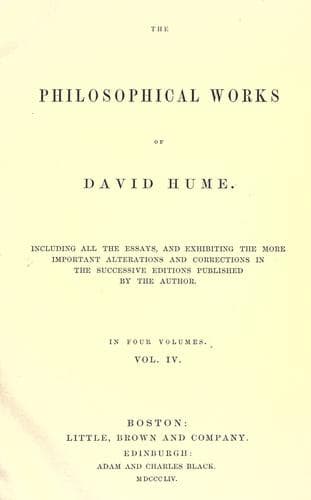
Philosophical Works, v. 1 (of 4): Including All the Essays, and Exhibiting the More Important Alterations and Corrections in the Successive Editions Published by the AuthorHume, David
PhilosophyPhilosophy
Philosophical Works, v. 1 (of 4): Including All the Essays, and Exhibiting the More Important Alterations and Corrections in the Successive Editions Published by the Author
Hume, David
Knowledge, Theory of; Philosophy, English -- 18th century
But, _secondly_,'tis equally obvious in this species of reasoning, that
if the transference of the past to the future were founded merely on
a conclusion of the understanding, it could never occasion any belief
or assurance. When we transfer contrary experiments to the future,
we can only repeat these contrary experiments with their particular
proportions; which could not produce assurance in any single event upon
which we reason, unless the fancy melted together all those images
that concur, and extracted from them one single idea or image, which
is intense and lively in proportion to the number of experiments from
which it is derived, and their superiority above their antagonists.
Our past experience presents no determinate object; and as our belief,
however faint, fixes itself on a determinate object, 'tis evident that
the belief arises not merely from the transference of past to future,
but from some operation of the _fancy_ conjoined with it. This may lead
us to conceive the manner in which that faculty enters into all our
reasonings.
I shall conclude this subject with two reflections which may deserve
our attention. The _first_ may be explained after this manner: When
the mind forms a reasoning concerning any matter of fact, which is
only probable, it casts its eye backward upon past experience, and,
transferring it to the future, is presented with so many contrary
views of its object, of which those that are of the same kind uniting
together and running into one act of the mind, serve to fortify and
enliven it. But suppose that this multitude of views or glimpses of an
object proceeds not from experience, but from a voluntary act of the
imagination; this effect does not follow, or, at least, follows not in
the same degree. For though custom and education produce belief by
such a repetition as is not derived from experience, yet this requires
a long tract of time, along with a very frequent and _undesigned_
repetition. In general we may pronounce, that a person, who would
_voluntarily_ repeat any idea in his mind, though supported by one
past experience, would be no more inclined to believe the existence of
its object, than if he had contented himself with one survey of it.
Beside the effect of design, each act of the mind, being separate and
independent, has a separate influence, and joins not its force with
that of its fellows. Not being united by any common object producing
them, they have no relation to each other; and consequently make no
transition or union of forces. This phenomenon we shall understand
better afterwards.
Public-domain text, read in full here on John Shaqi.
Reviews
Reviews
No reviews yet
Be the first to share your thoughts on this work.
Elsewhere in the archive
Join the Discussion
Join the discussion
Sign in to leave a comment or review.
Sign InorCreate an account