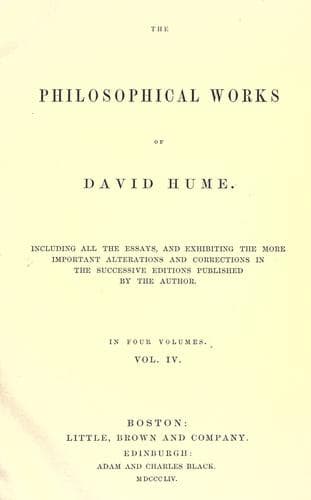
Philosophical Works, v. 1 (of 4): Including All the Essays, and Exhibiting the More Important Alterations and Corrections in the Successive Editions Published by the AuthorHume, David
PhilosophyPhilosophy
Philosophical Works, v. 1 (of 4): Including All the Essays, and Exhibiting the More Important Alterations and Corrections in the Successive Editions Published by the Author
Hume, David
Knowledge, Theory of; Philosophy, English -- 18th century
But why need we seek for other instances, while the present subject
of philosophical probabilities offers us so obvious an one, in
the opposition betwixt the judgment and imagination, arising from
these effects of custom? According to my system, all reasonings are
nothing but the effects of custom, and custom has no influence, but
by enlivening the imagination, and giving us a strong conception of
any object. It may therefore be concluded, that our judgment and
imagination can never be contrary, and that custom cannot operate on
the latter faculty after such a manner, as to render it opposite to
the former. This difficulty we can remove after no other manner, than
by supposing the influence of general rules. We shall afterwards[10]
take notice of some general rules, by which we ought to regulate
our judgment concerning causes and effects; and these rules are
formed on the nature of our understanding, and on our experience
of its operations in the judgments we form concerning objects. By
them we learn to distinguish the accidental circumstances from the
efficacious causes; and when we find that an effect can be produced
without the concurrence of any particular circumstance, we conclude
that that circumstance makes not a part of the efficacious cause,
however frequently conjoined with it. But as this frequent conjunction
necessarily makes it have some effect on the imagination, in spite of
the opposite conclusion from general rules, the opposition of these
two principles produces a contrariety in our thoughts, and causes us
to ascribe the one inference to our judgment, and the other to our
imagination. The general rule is attributed to our judgment, as being
more extensive and constant; the exception to the imagination, as being
more capricious and uncertain.
Public-domain text, read in full here on John Shaqi.
Reviews
Reviews
No reviews yet
Be the first to share your thoughts on this work.
Elsewhere in the archive
Join the Discussion
Join the discussion
Sign in to leave a comment or review.
Sign InorCreate an account