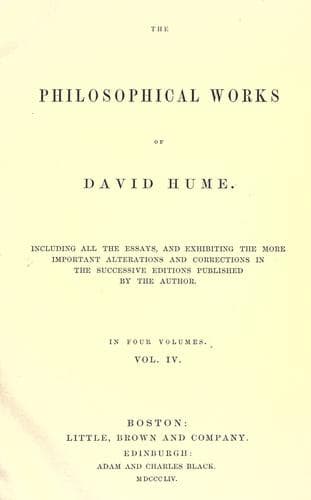
Philosophical Works, v. 1 (of 4): Including All the Essays, and Exhibiting the More Important Alterations and Corrections in the Successive Editions Published by the AuthorHume, David
PhilosophyPhilosophy
Philosophical Works, v. 1 (of 4): Including All the Essays, and Exhibiting the More Important Alterations and Corrections in the Successive Editions Published by the Author
Hume, David
Knowledge, Theory of; Philosophy, English -- 18th century
Thus, our general rules are in a manner set in opposition to each
other. When an object appears, that resembles any cause in very
considerable circumstances, the imagination naturally carries us to a
lively conception of the usual effect, though the object be different
in the most material and most efficacious circumstances from that
cause. Here is the first influence of general rules. But when we
take a review of this act of the mind, and compare it with the more
general and authentic operations of the understanding, we find it to
be of an irregular nature, and destructive of all the most established
principles of reasonings, which is the cause of our rejecting it. This
is a second influence of general rules, and implies the condemnation
of the former. Sometimes the one, sometimes the other prevails,
according to the disposition and character of the person. The vulgar
are commonly guided by the first, and wise men by the second. Meanwhile
the sceptics may here have the pleasure of observing a new and signal
contradiction in our reason, and of seeing all philosophy ready to be
subverted by a principle of human nature, and again saved by a new
direction of the very same principle. The following of general rules
is a very unphilosophical species of probability; and yet 'tis only by
following them that we can correct this, and all other unphilosophical
probabilities.
Since we have instances where general rules operate on the imagination,
even contrary to the judgment, we need not be surprised to see their
effects increase, when conjoined with that latter faculty, and to
observe that they bestow on the ideas they present to us a force
superior to what attends any other. Every one knows there is an
indirect manner of insinuating praise or blame, which is much less
shocking than the open flattery or censure of any person. However he
may communicate his sentiments by such secret insinuations, and make
them known with equal certainty as by the open discovery of them,
'tis certain that their influence is not equally strong and powerful.
One who lashes me with concealed strokes of satire, moves not my
indignation to such a degree, as if he flatly told me I was a fool and
a coxcomb; though I equally understand his meaning, as if he did. This
difference is to be attributed to the influence of general rules.
Public-domain text, read in full here on John Shaqi.
Reviews
Reviews
No reviews yet
Be the first to share your thoughts on this work.
Elsewhere in the archive
Join the Discussion
Join the discussion
Sign in to leave a comment or review.
Sign InorCreate an account