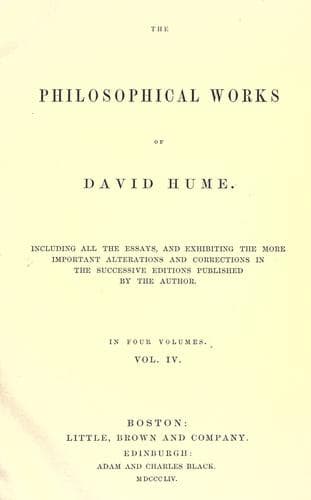
Philosophical Works, v. 1 (of 4): Including All the Essays, and Exhibiting the More Important Alterations and Corrections in the Successive Editions Published by the AuthorHume, David
PhilosophyPhilosophy
Philosophical Works, v. 1 (of 4): Including All the Essays, and Exhibiting the More Important Alterations and Corrections in the Successive Editions Published by the Author
Hume, David
Knowledge, Theory of; Philosophy, English -- 18th century
Whether a person openly abuses me, or slily intimates his contempt,
in neither case do I immediately perceive his sentiment or opinion;
and 'tis only by signs, that is, by its effects, I become sensible of
it. The only difference then, betwixt these two cases, consists in
this, that in the open discovery of his sentiments he makes use of
signs, which are general and universal; and in the secret intimation
employs such as are more singular and uncommon. The effect of this
circumstance is, that the imagination, in running from the present
impression to the absent idea, makes the transition with greater
facility, and consequently conceives the object with greater force,
where the connexion is common and universal, than where it is more rare
and particular. Accordingly, we may observe, that the open declaration
of our sentiments is called the taking off the mask, as the secret
intimation of our opinions is said to be the veiling of them. The
difference betwixt an idea produced by a general connexion, and that
arising from a particular one, is here compared to the difference
betwixt an impression and an idea. This difference in the imagination
has a suitable effect on the passions, and this effect is augmented by
another circumstance. A secret intimation of anger or contempt shows
that we still have some consideration for the person, and avoid the
directly abusing him. This makes a concealed satire less disagreeable,
but still this depends on the same principle. For if an idea were not
more feeble, when only intimated, it would never be esteemed a mark of
greater respect to proceed in this method than in the other.
Sometimes scurrility is less displeasing than delicate satire, because
it revenges us in a manner for the injury at the very time it is
committed, by affording us a just reason to blame and contemn the
person who injures us. But this phenomenon likewise depends upon the
same principle. For why do we blame all gross and injurious language,
unless it be, because we esteem it contrary to good breeding and
humanity? And why is it contrary, unless it be more shocking than any
delicate satire? The rules of good breeding condemn whatever is openly
disobliging, and gives a sensible pain and confusion to those with
whom we converse. After this is once established, abusive language is
universally blamed, and gives less pain upon account of its coarseness
and incivility, which render the person despicable that employs it. It
becomes less disagreeable, merely because originally it is more so; and
'tis more disagreeable, because it affords an inference by general and
common rules that are palpable and undeniable.
Public-domain text, read in full here on John Shaqi.
Reviews
Reviews
No reviews yet
Be the first to share your thoughts on this work.
Elsewhere in the archive
Join the Discussion
Join the discussion
Sign in to leave a comment or review.
Sign InorCreate an account