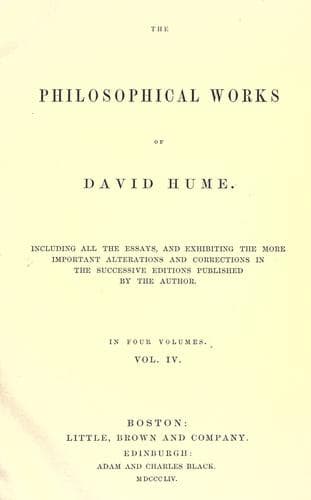
Philosophical Works, v. 1 (of 4): Including All the Essays, and Exhibiting the More Important Alterations and Corrections in the Successive Editions Published by the AuthorHume, David
PhilosophyPhilosophy
Philosophical Works, v. 1 (of 4): Including All the Essays, and Exhibiting the More Important Alterations and Corrections in the Successive Editions Published by the Author
Hume, David
Knowledge, Theory of; Philosophy, English -- 18th century
The same conclusion is unavoidable upon the hypothesis of those, who
maintain the efficacy of second causes, and attribute a derivative, but
a real power and energy to matter. For as they confess that this energy
lies not in any of the known qualities of matter, the difficulty still
remains concerning the origin of its idea. If we have really an idea
of power, we may attribute power to an unknown quality: but as 'tis
impossible that that idea can be derived from such a quality, and as
there is nothing in known qualities which can produce it, it follows
that we deceive ourselves, when we imagine we are possessed of any idea
of this kind, after the manner we commonly understand it. All ideas are
derived from, and represent impressions. We never have any impression
that contains any power or efficacy. We never, therefore, have any idea
of power.
Some have asserted, that we feel an energy or power in our own mind;
and that, having in this manner acquired the idea of power, we transfer
that quality to matter, where we are not able immediately to discover
it. The motions of our body, and the thoughts and sentiments of our
mind (say they) obey the will; nor do we seek any farther to acquire
a just notion of force or power. But to convince us how fallacious
this reasoning is, we need only consider, that the will being here
considered as a cause, has no more a discoverable connexion with its
effects, than any material cause has with its proper effect. So far
from perceiving the connexion betwixt an act of volition and a motion
of the body, 'tis allowed that no effect is more inexplicable from
the powers and essence of thought and matter. Nor is the empire
of the will over our mind more intelligible. The effect is there
distinguishable and separable from the cause, and could be foreseen
without the experience of their constant conjunction. We have command
over our mind to a certain degree, but beyond _that_ lose all empire
over it: and 'tis evidently impossible to fix any precise bounds to
our authority, where we consult not experience. In short, the actions
of the mind are, in this respect, the same with those of matter. We
perceive only their constant conjunction; nor can we ever reason beyond
it. No internal impression has an apparent energy, more than external
objects have. Since, therefore, matter is confessed by philosophers to
operate by an unknown force, we should in vain hope to attain an idea
of force by consulting our own minds.[15]
Public-domain text, read in full here on John Shaqi.
Reviews
Reviews
No reviews yet
Be the first to share your thoughts on this work.
Elsewhere in the archive
Join the Discussion
Join the discussion
Sign in to leave a comment or review.
Sign InorCreate an account