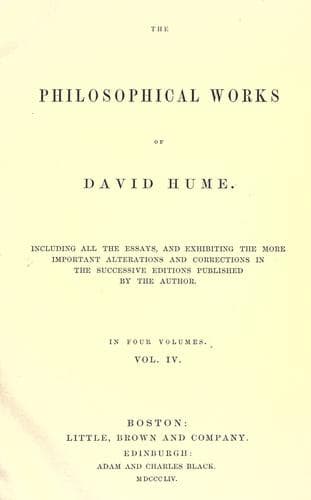
Philosophical Works, v. 1 (of 4): Including All the Essays, and Exhibiting the More Important Alterations and Corrections in the Successive Editions Published by the AuthorHume, David
PhilosophyPhilosophy
Philosophical Works, v. 1 (of 4): Including All the Essays, and Exhibiting the More Important Alterations and Corrections in the Successive Editions Published by the Author
Hume, David
Knowledge, Theory of; Philosophy, English -- 18th century
It has been established as a certain principle, that general or
abstract ideas are nothing but individual ones taken in a certain
light, and that, in reflecting on any object, 'tis as impossible to
exclude from our thought all particular degrees of quantity and quality
as from the real nature of things. If we be possessed, therefore, of
any idea of power in general, we must also be able to conceive some
particular species of it; and as power cannot subsist alone, but is
always regarded as an attribute of some being or existence, we must
be able to place this power in some particular being, and conceive
that being as endowed with a real force and energy, by which such a
particular effect necessarily results from its operation. We must
distinctly and particularly conceive the connexion betwixt the cause
and effect, and be able to pronounce, from a simple view of the one,
that it must be followed or preceded by the other. This is the true
manner of conceiving a particular power in a particular body: and a
general idea being impossible without an individual; where the latter
is impossible, 'tis certain the former can never exist. Now nothing
is more evident, than that the human mind cannot form such an idea of
two objects, as to conceive any connexion betwixt them, or comprehend
distinctly that power or efficacy, by which they are united. Such a
connexion would amount to a demonstration, and would imply the absolute
impossibility for the one object not to follow, or to be conceived not
to follow upon the other: which kind of connexion has already been
rejected in all cases. If any one is of a contrary opinion, and thinks
he has attained a notion of power in any particular object, I desire he
may point out to me that object. But till I meet with such a one, which
I despair of, I cannot forbear concluding, that since we can never
distinctly conceive how any particular power can possibly reside in any
particular object, we deceive ourselves in imagining we can form any
such general idea.
Thus, upon the whole, we may infer, that when we talk of any being,
whether of a superior or inferior nature, as endowed with a power
or force, proportioned to any effect; when we speak of a necessary
connexion betwixt objects, and suppose that this connexion depends upon
an efficacy or energy, with which any of these objects are endowed; in
all the expressions, _so applied_, we have really no distinct meaning,
and make use only of common words, without any clear and determinate
ideas. But as 'tis more probable, that these expressions do here lose
their true meaning by being _wrong applied_, than that they never have
any meaning; 'twill be proper to bestow another consideration on this
subject, to see if possibly we can discover the nature and origin of
those ideas we annex to them.
Public-domain text, read in full here on John Shaqi.
Reviews
Reviews
No reviews yet
Be the first to share your thoughts on this work.
Elsewhere in the archive
Join the Discussion
Join the discussion
Sign in to leave a comment or review.
Sign InorCreate an account