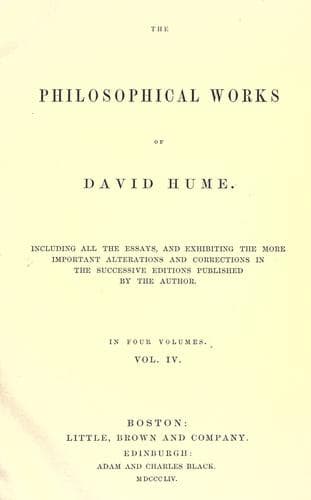
Philosophical Works, v. 1 (of 4): Including All the Essays, and Exhibiting the More Important Alterations and Corrections in the Successive Editions Published by the AuthorHume, David
PhilosophyPhilosophy
Philosophical Works, v. 1 (of 4): Including All the Essays, and Exhibiting the More Important Alterations and Corrections in the Successive Editions Published by the Author
Hume, David
Knowledge, Theory of; Philosophy, English -- 18th century
Thus, as the necessity, which makes two times two equal to four, or
three angles of a triangle equal to two right ones, lies only in the
act of the understanding, by which we consider and compare these
ideas; in like manner, the necessity of power, which unites causes and
effects, lies in the determination of the mind to pass from the one to
the other. The efficacy or energy of causes is neither placed in the
causes themselves, nor in the Deity, nor in the concurrence of these
two principles; but belongs entirely to the soul, which considers the
union of two or more objects in all past instances. 'Tis here that
the real power of causes is placed, along with their connexion and
necessity.
I am sensible, that of all the paradoxes which I have had, or shall
hereafter have occasion to advance in the course of this Treatise,
the present one is the most violent, and that 'tis merely by dint of
solid proof and reasoning I can ever hope it will have admission, and
overcome the inveterate prejudices of mankind. Before we are reconciled
to this doctrine, how often must we repeat to ourselves, _that_ the
simple view of any two objects or actions, however related, can never
give us any idea of power, or of a connexion betwixt them: _that_ this
idea arises from the repetition of their union: _that_ the repetition
neither discovers nor causes any thing in the objects, but has an
influence only on the mind, by that customary transition it produces:
_that_ this customary transition is therefore the same with the power
and necessity; which are consequently qualities of perceptions, not
of objects, and are internally felt by the soul, and not perceived
externally in bodies? There is commonly an astonishment attending every
thing extraordinary; and this astonishment changes immediately into
the highest degree of esteem or contempt, according as we approve or
disapprove of the subject. I am much afraid, that though the foregoing
reasoning appears to me the shortest and most decisive imaginable, yet,
with the generality of readers, the bias of the mind will prevail, and
give them a prejudice against the present doctrine.
Public-domain text, read in full here on John Shaqi.
Reviews
Reviews
No reviews yet
Be the first to share your thoughts on this work.
Elsewhere in the archive
Join the Discussion
Join the discussion
Sign in to leave a comment or review.
Sign InorCreate an account