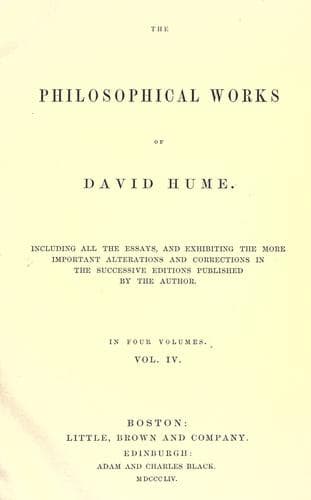
Philosophical Works, v. 1 (of 4): Including All the Essays, and Exhibiting the More Important Alterations and Corrections in the Successive Editions Published by the AuthorHume, David
PhilosophyPhilosophy
Philosophical Works, v. 1 (of 4): Including All the Essays, and Exhibiting the More Important Alterations and Corrections in the Successive Editions Published by the Author
Hume, David
Knowledge, Theory of; Philosophy, English -- 18th century
Though the several resembling instances, which give rise to the idea
of power, have no influence on each other, and can never produce any
new quality _in the object_, which can be the model of that idea,
yet the _observation_ of this resemblance produces a new impression
_in the mind_, which is its real model. For after we have observed
the resemblance in a sufficient number of instances, we immediately
feel a determination of the mind to pass from one object to its usual
attendant, and to conceive it in a stronger light upon account of that
relation. This determination is the only effect of the resemblance;
and therefore must be the same with power or efficacy, whose idea is
derived from the resemblance. The several instances of resembling
conjunctions lead us into the notion of power and necessity. These
instances are in themselves totally distinct from each other, and have
no union but in the mind, which observes them, and collects their
ideas. Necessity, then, is the effect of this observation, and as
nothing but an internal impression of the mind, or a determination to
carry our thoughts from one object to another. Without considering it
in this view, we can never arrive at the most distant notion of it,
or be able to attribute it either to external or internal objects, to
spirit or body, to causes or effects.
The necessary connexion betwixt causes and effects is the foundation of
our inference from one to the other. The foundation of our inference is
the transition arising from the accustomed union. These are therefore
the same.
The idea of necessity arises from some impression. There is no
impression conveyed by our senses, which can give rise to that idea.
It must, therefore, be derived from some internal impression, or
impression of reflection. There is no internal impression which has any
relation to the present business, but that propensity, which custom
produces, to pass from an object to the idea of its usual attendant.
This, therefore, is the essence of necessity. Upon the whole, necessity
is something that exists in the mind, not in objects; nor is it
possible for us ever to form the most distant idea of it, considered as
a quality in bodies. Either we have no idea of necessity, or necessity
is nothing but that determination of the thought to pass from causes
to effects, and from effects to causes, according to their experienced
union.
Public-domain text, read in full here on John Shaqi.
Reviews
Reviews
No reviews yet
Be the first to share your thoughts on this work.
Elsewhere in the archive
Join the Discussion
Join the discussion
Sign in to leave a comment or review.
Sign InorCreate an account