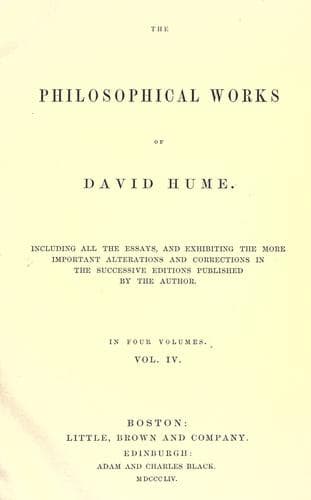
Philosophical Works, v. 1 (of 4): Including All the Essays, and Exhibiting the More Important Alterations and Corrections in the Successive Editions Published by the AuthorHume, David
PhilosophyPhilosophy
Philosophical Works, v. 1 (of 4): Including All the Essays, and Exhibiting the More Important Alterations and Corrections in the Successive Editions Published by the Author
Hume, David
Knowledge, Theory of; Philosophy, English -- 18th century
Having thus found in every probability, beside the original uncertainty
inherent in the subject, a new uncertainty, derived from the
weakness of that faculty which judges, and having adjusted these two
together, we are obliged by our reason to add a new doubt, derived
from the possibility of error in the estimation we make of the truth
and fidelity of our faculties. This is a doubt which immediately
occurs to us, and of which, if we would closely pursue our reason,
we cannot avoid giving a decision. But this decision, though it
should be favourable to our preceding judgment, being founded only
on probability, must weaken still further our first evidence, and
must itself be weakened by a fourth doubt of the same kind, and so
on _in infinitum_; till at last there remain nothing of the original
probability, however great we may suppose it to have been, and however
small the diminution by every new uncertainty. No finite object can
subsist under a decrease repeated _in infinitum_; and even the vastest
quantity, which can enter into human imagination, must in this manner
be reduced to nothing. Let our first belief be never so strong, it must
infallibly perish, by passing through so many new examinations, of
which each diminishes somewhat of its force and vigour. When I reflect
on the natural fallibility of my judgment, I have less confidence in
my opinions, than when I only consider the objects concerning which I
reason; and when I proceed still farther, to turn the scrutiny against
every successive estimation I make of my faculties, all the rules of
logic require a continual diminution, and at last a total extinction of
belief and evidence.
Should it here be asked me, whether I sincerely assent to this
argument, which I seem to take such pains to inculcate, and whether I
be really one of those sceptics, who hold that all is uncertain, and
that our judgment is not in _any_ thing possessed of _any_ measures of
truth and falsehood; I should reply, that this question is entirely
superfluous, and that neither I, nor any other person, was ever
sincerely and constantly of that opinion. Nature, by an absolute and
uncontrollable necessity, has determined us to judge as well as to
breathe and feel; nor can we any more forbear viewing certain objects
in a stronger and fuller light, upon account of their customary
connexion with a present impression, than we can hinder ourselves from
thinking, as long as we are awake, or seeing the surrounding bodies,
when we turn our eyes towards them in broad sunshine. Whoever has
taken the pains to refute the cavils of this _total_ scepticism, has
really disputed without an antagonist, and endeavoured by arguments to
establish a faculty, which nature has antecedently implanted in the
mind, and rendered unavoidable.
Public-domain text, read in full here on John Shaqi.
Reviews
Reviews
No reviews yet
Be the first to share your thoughts on this work.
Elsewhere in the archive
Join the Discussion
Join the discussion
Sign in to leave a comment or review.
Sign InorCreate an account