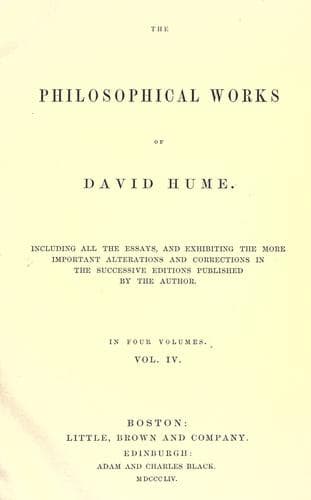
Philosophical Works, v. 1 (of 4): Including All the Essays, and Exhibiting the More Important Alterations and Corrections in the Successive Editions Published by the AuthorHume, David
PhilosophyPhilosophy
Philosophical Works, v. 1 (of 4): Including All the Essays, and Exhibiting the More Important Alterations and Corrections in the Successive Editions Published by the Author
Hume, David
Knowledge, Theory of; Philosophy, English -- 18th century
My intention then in displaying so carefully the arguments of that
fantastic sect, is only to make the reader sensible of the truth of my
hypothesis, _that all our reasonings concerning causes and effects,
are derived from nothing but custom; and that belief is more properly
an act of the sensitive, than of the cogitative part of our natures_.
I have here proved, that the very same principles, which make us
form a decision upon any subject, and correct that decision by the
consideration of our genius and capacity, and of the situation of our
mind, when we examined that subject; I say, I have proved, that these
same principles, when carried farther, and applied to every new reflex
judgment, must, by continually diminishing the original evidence, at
last reduce it to nothing, and utterly subvert all belief and opinion.
If belief, therefore, were a simple act of the thought, without any
peculiar manner of conception, or the addition or a force and vivacity,
it must infallibly destroy itself, and in every case terminate in
a total suspense of judgment. But as experience will sufficiently
convince any one, who thinks it worth while to try, that though he
can find no error in the foregoing arguments, yet he still continues
to believe, and think, and reason, as usual, he may safely conclude,
that his reasoning and belief is some sensation or peculiar manner of
conception, which 'tis impossible for mere ideas and reflections to
destroy.
But here, perhaps, it may be demanded, how it happens, even upon my
hypothesis, that these arguments above explained produce not a total
suspense of judgment, and after what manner the mind ever retains a
degree of assurance in any subject? For as these new probabilities,
which, by their repetition, perpetually diminish the original
evidence, are founded on the very same principles, whether of thought
or sensation, as the primary judgment, it may seem unavoidable, that
in either case they must equally subvert it, and by the opposition,
either of contrary thoughts or sensations, reduce the mind to a total
uncertainty. I suppose there is some question proposed to me, and
that, after revolving over the impressions of my memory and senses,
and carrying my thoughts from them to such objects as are commonly
conjoined with them, I feel a stronger and more forcible conception
on the one side than on the other. This strong conception forms my
first decision. I suppose, that afterwards I examine my judgment
itself, and observing, from experience, that 'tis sometimes just and
sometimes erroneous, I consider it as regulated by contrary principles
or causes, of which some lead to truth, and some to error; and in
balancing these contrary causes, I diminish, by a new probability,
the assurance of my first decision. This new probability is liable to
the same diminution as the foregoing, and so on, _in infinitum_. 'Tis
therefore demanded, _how it happens, that, even after all, we retain
Public-domain text, read in full here on John Shaqi.
Reviews
Reviews
No reviews yet
Be the first to share your thoughts on this work.
Elsewhere in the archive
Join the Discussion
Join the discussion
Sign in to leave a comment or review.
Sign InorCreate an account