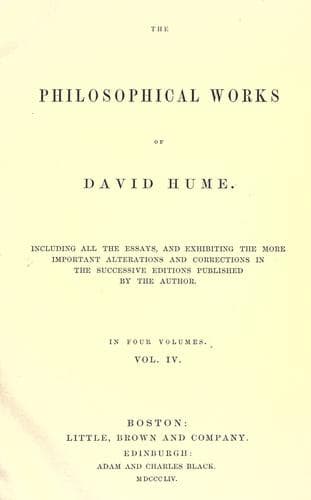
Philosophical Works, v. 1 (of 4): Including All the Essays, and Exhibiting the More Important Alterations and Corrections in the Successive Editions Published by the AuthorHume, David
PhilosophyPhilosophy
Philosophical Works, v. 1 (of 4): Including All the Essays, and Exhibiting the More Important Alterations and Corrections in the Successive Editions Published by the Author
Hume, David
Knowledge, Theory of; Philosophy, English -- 18th century
That our senses offer not their impressions as the images of something
_distinct_, or _independent_, and _external_, is evident; because
they convey to us nothing but a single perception, and never give us
the least intimation of any thing beyond. A single perception can
never produce the idea of a double existence, but by some inference
either of the reason or imagination. When the mind looks farther than
what immediately appears to it, its conclusions can never be put to
the account of the senses; and it certainly looks farther, when from
a single perception it infers a double existence, and supposes the
relations of resemblance and causation betwixt them.
If our senses, therefore, suggest any idea of distinct existences,
they must convey the impressions as those very existences, by a kind
of fallacy and illusion. Upon this head we may observe, that all
sensations are felt by the mind, such as they really are, and that,
when we doubt whether they present themselves as distinct objects, or
as mere impressions, the difficulty is not concerning their nature, but
concerning their relations and situation. Now, if the senses presented
our impressions as external to, and independent of ourselves, both the
objects and ourselves must be obvious to our senses, otherwise they
could not be compared by these faculties. The difficulty then, is, how
far we are _ourselves_ the objects of our senses.
'Tis certain there is no question in philosophy more abstruse than that
concerning identity, and the nature of the uniting principle, which
constitutes a person. So far from being able by our senses merely to
determine this question, we must have recourse to the most profound
metaphysics to give a satisfactory answer to it; and in common life
'tis evident these ideas of self and person are never very fixed nor
determinate. 'Tis absurd therefore to imagine the senses can ever
distinguish betwixt ourselves and external objects.
Add to this, that every impression, external and internal, passions,
affections, sensations, pains and pleasures, are originally on the
same footing; and that whatever other differences we may observe among
them, they appear, all of them, in their true colours, as impressions
or perceptions. And indeed, if we consider the matter aright, 'tis
scarce possible it should be otherwise; nor is it conceivable that
our senses should be more capable of deceiving us in the situation
and relations, than in the nature of our impressions. For since all
actions and sensations of the mind are known to us by consciousness,
they must necessarily appear in every particular what they are, and be
what they appear. Every thing that enters the mind, being in _reality_
as the perception, 'tis impossible any thing should to _feeling_ appear
different. This were to suppose, that even where we are most intimately
conscious, we might be mistaken.
Public-domain text, read in full here on John Shaqi.
Reviews
Reviews
No reviews yet
Be the first to share your thoughts on this work.
Elsewhere in the archive
Join the Discussion
Join the discussion
Sign in to leave a comment or review.
Sign InorCreate an account