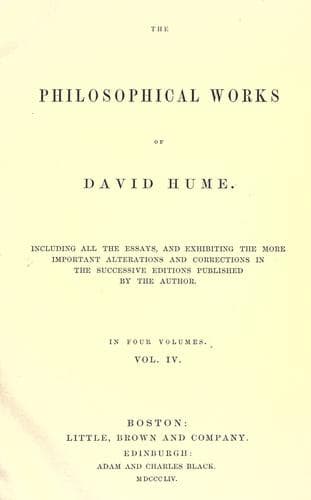
Philosophical Works, v. 1 (of 4): Including All the Essays, and Exhibiting the More Important Alterations and Corrections in the Successive Editions Published by the AuthorHume, David
PhilosophyPhilosophy
Philosophical Works, v. 1 (of 4): Including All the Essays, and Exhibiting the More Important Alterations and Corrections in the Successive Editions Published by the Author
Hume, David
Knowledge, Theory of; Philosophy, English -- 18th century
But not to lose time in examining, whether 'tis possible for our
senses to deceive us, and represent our perceptions as distinct from
ourselves, that is, as _external_ to and _independent_ of us; let us
consider whether they really do so, and whether this error proceeds
from an immediate sensation, or from some other causes.
To begin with the question concerning _external_ existence, it may
perhaps be said, that setting aside the metaphysical question of the
identity of a thinking substance, our own body evidently belongs
to us; and as several impressions appear exterior to the body, we
suppose them also exterior to ourselves. The paper, on which I write
at present, is beyond my hand. The table is beyond the paper. The
walls of the chamber beyond the table. And in casting my eye towards
the window, I perceive a great extent of fields and buildings beyond
my chamber. From all this it may be inferred, that no other faculty is
required, beside the senses, to convince us of the external existence
of body. But to prevent this inference, we need only weigh the three
following considerations. _First_, that, properly speaking, 'tis not
our body we perceive, when we regard our limbs and members, but certain
impressions, which enter by the senses; so that the ascribing a real
and corporeal existence to these impressions, or to their objects, is
an act of the mind as difficult to explain as that which we examine at
present. _Secondly_, sounds, and tastes, and smells, though commonly
regarded by the mind as continued independent qualities, appear not to
have any existence in extension, and consequently cannot appear to the
senses as situated externally to the body. The reason why we ascribe a
place to them, shall be considered afterwards.[2] _Thirdly_, even our
sight informs us not of distance or outness (so to speak) immediately
and without a certain reasoning and experience, as is acknowledged by
the most rational philosophers.
As to the _independency_ of our perceptions on ourselves, this can
never be an object of the senses; but any opinion we form concerning
it, must be derived from experience and observation: and we shall see
afterwards, that our conclusions from experience are far from being
favourable to the doctrine of the independency of our perceptions.
Meanwhile we may observe, that when we talk of real distinct
existences, we have commonly more in our eye their independency than
external situation in place, and think an object has a sufficient
reality, when its being is uninterrupted, and independent of the
incessant revolutions, which we are conscious of in ourselves.
Public-domain text, read in full here on John Shaqi.
Reviews
Reviews
No reviews yet
Be the first to share your thoughts on this work.
Elsewhere in the archive
Join the Discussion
Join the discussion
Sign in to leave a comment or review.
Sign InorCreate an account