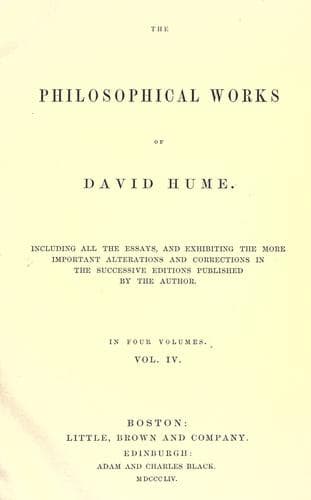
Philosophical Works, v. 1 (of 4): Including All the Essays, and Exhibiting the More Important Alterations and Corrections in the Successive Editions Published by the AuthorHume, David
PhilosophyPhilosophy
Philosophical Works, v. 1 (of 4): Including All the Essays, and Exhibiting the More Important Alterations and Corrections in the Successive Editions Published by the Author
Hume, David
Knowledge, Theory of; Philosophy, English -- 18th century
We may also observe, in this instance of sounds and colours, that we
can attribute a distinct continued existence to objects without ever
consulting _reason_, or weighing our opinions by any philosophical
principles. And, indeed, whatever convincing arguments philosophers may
fancy they can produce to establish the belief of objects independent
of the mind, 'tis obvious these arguments are known but to very few;
and that 'tis not by them that children, peasants, and the greatest
part of mankind, are induced to attribute objects to some impressions,
and deny them to others. Accordingly, we find, that all the conclusions
which the vulgar form on this head, are directly contrary to those
which are confirmed by philosophy. For philosophy informs us, that
every thing which appears to the mind, is nothing but a perception,
and is interrupted and dependent on the mind; whereas the vulgar
confound perceptions and objects, and attribute a distinct continued
existence to the very things they feel or see. This sentiment, then,
as it is entirely unreasonable, must proceed from some other faculty
than the understanding. To which we may add, that, as long as we take
our perceptions and objects to be the same, we can never infer the
existence of the one from that of the other, nor form any argument
from the relation of cause and effect; which is the only one that can
assure us of matter of fact. Even after we distinguish our perceptions
from our objects, 'twill appear presently that we are still incapable
of reasoning from the existence of one to that of the other: so that,
upon the whole, our reason neither does, nor is it possible it ever
should, upon any supposition, give us an assurance of the continued and
distinct existence of body. That opinion must be entirely owing to the
_imagination_: which must now be the subject of our inquiry.
Since all impressions are internal and perishing existences, and
appear as such, the notion of their distinct and continued existence
must arise from a concurrence of some of their qualities with the
qualities of the imagination; and since this notion does not extend
to all of them, it must arise from certain qualities peculiar to some
impressions. 'Twill, therefore, be easy for us to discover these
qualities by a comparison of the impressions, to which we attribute
a distinct and continued existence, with those which we regard as
internal and perishing.
Public-domain text, read in full here on John Shaqi.
Reviews
Reviews
No reviews yet
Be the first to share your thoughts on this work.
Elsewhere in the archive
Join the Discussion
Join the discussion
Sign in to leave a comment or review.
Sign InorCreate an account