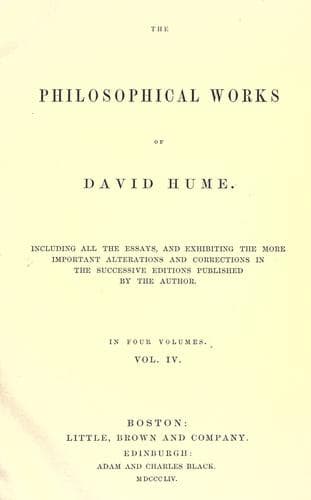
Philosophical Works, v. 1 (of 4): Including All the Essays, and Exhibiting the More Important Alterations and Corrections in the Successive Editions Published by the AuthorHume, David
PhilosophyPhilosophy
Philosophical Works, v. 1 (of 4): Including All the Essays, and Exhibiting the More Important Alterations and Corrections in the Successive Editions Published by the Author
Hume, David
Knowledge, Theory of; Philosophy, English -- 18th century
We may observe, then, that 'tis neither upon account of the
involuntariness of certain impressions, as is commonly supposed, nor of
their superior force and violence, that we attribute to them a reality
and continued existence, which we refuse to others that are voluntary
or feeble. For 'tis evident, our pains and pleasures, our passions and
affections, which we never suppose to have any existence beyond our
perception, operate with greater violence, and are equally involuntary,
as the impressions of figure and extension, colour and sound, which we
suppose to be permanent beings. The heat of a fire, when moderate, is
supposed to exist in the fire; but the pain which it causes upon a near
approach is not taken to have any being except in the perception.
These vulgar opinions, then, being rejected, we must search for some
other hypothesis, by which we may discover those peculiar qualities
in our impressions, which makes us attribute to them a distinct and
continued existence.
After a little examination, we shall find, that all those objects, to
which we attribute a continued existence, have a peculiar _constancy_,
which distinguishes them from the impressions whose existence depends
upon our perception. Those mountains, and houses, and trees, which lie
at present under my eye, have always appeared to me in the same order;
and when I lose sight of them by shutting my eyes or turning my head,
I soon after find them return upon me without the least alteration.
My bed and table, my books and papers, present themselves in the same
uniform manner, and change not upon account of any interruption in my
seeing or perceiving them. This is the case with all the impressions,
whose objects are supposed to have an external existence; and is the
case with no other impressions, whether gentle or violent, voluntary or
involuntary.
This constancy, however, is not so perfect as not to admit of very
considerable exceptions. Bodies often change their position and
qualities, and, after a little absence or interruption, may become
hardly knowable. But here 'tis observable, that even in these changes
they preserve a _coherence_, and have a regular dependence on each
other; which is the foundation of a kind of reasoning from causation,
and produces the opinion of their continued existence. When I return
to my chamber after an hour's absence, I find not my fire in the same
situation in which I left it; but then I am accustomed, in other
instances, to see a like alteration produced in a like time, whether
I am present or absent, near or remote. This coherence, therefore, in
their changes, is one of the characteristics of external objects, as
well as their constancy.
Public-domain text, read in full here on John Shaqi.
Reviews
Reviews
No reviews yet
Be the first to share your thoughts on this work.
Elsewhere in the archive
Join the Discussion
Join the discussion
Sign in to leave a comment or review.
Sign InorCreate an account