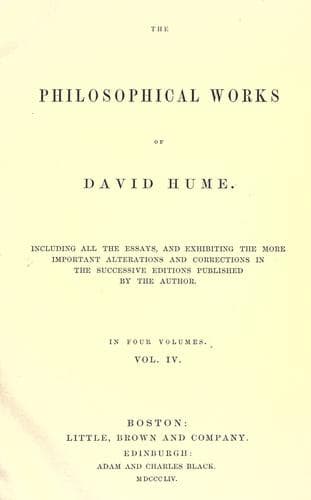
Philosophical Works, v. 1 (of 4): Including All the Essays, and Exhibiting the More Important Alterations and Corrections in the Successive Editions Published by the AuthorHume, David
PhilosophyPhilosophy
Philosophical Works, v. 1 (of 4): Including All the Essays, and Exhibiting the More Important Alterations and Corrections in the Successive Editions Published by the Author
Hume, David
Knowledge, Theory of; Philosophy, English -- 18th century
Having found that the opinion of the continued existence of body
depends on the _coherence_ and _constancy_ of certain impressions, I
now proceed to examine after what manner these qualities give rise
to so extraordinary an opinion. To begin with the coherence; we may
observe, that though those internal impressions, which we regard as
fleeting and perishing, have also a certain coherence or regularity
in their appearances, yet 'tis of somewhat a different nature from
that which we discover in bodies. Our passions are found by experience
to have a mutual connexion with, and dependence on each other; but
on no occasion is it necessary to suppose that they have existed and
operated, when they were not perceived, in order to preserve the same
dependence and connexion, of which we have had experience. The case
is not the same with relation to external objects. Those require
a continued existence, or otherwise lose, in a great measure, the
regularity of their operation. I am here seated in my chamber, with
my face to the fire; and all the objects that strike my senses are
contained in a few yards around me. My memory, indeed, informs me of
the existence of many objects; but, then, this information extends not
beyond their past existence, nor do either my senses or memory give any
testimony to the continuance of their being. When, therefore, I am thus
seated, and revolve over these thoughts, I hear on a sudden a noise as
of a door turning upon its hinges; and a little after see a porter, who
advances towards me. This gives occasion to many new reflections and
reasonings. First, I never have observed that this noise could proceed
from any thing but the motion of a door; and therefore conclude, that
the present phenomenon is a contradiction to all past experience,
unless the door, which I remember on t'other side the chamber, be still
in being. Again, I have always found, that a human body was possessed
of a quality which I call gravity, and which hinders it from mounting
in the air, as this porter must have done to arrive at my chamber,
unless the stairs I remember be not annihilated by my absence. But this
is not all. I receive a letter, which, upon opening it, I perceive by
the handwriting and subscription to have come from a friend, who says
he is two hundred leagues distant. 'Tis evident I can never account
for this phenomenon, conformable to my experience in other instances,
without spreading out in my mind the whole sea and continent between
us, and supposing the effects and continued existence of posts and
ferries, according to my memory and observation. To consider these
phenomena of the porter and letter in a certain light, they are
contradictions to common experience, and may be regarded as objections
to those maxims which we form concerning the connexions of causes and
effects. I am accustomed to hear such a sound, and see such an object
in motion at the same time. I have not received, in this particular
instance, both these perceptions.
Public-domain text, read in full here on John Shaqi.
Reviews
Reviews
No reviews yet
Be the first to share your thoughts on this work.
Elsewhere in the archive
Join the Discussion
Join the discussion
Sign in to leave a comment or review.
Sign InorCreate an account