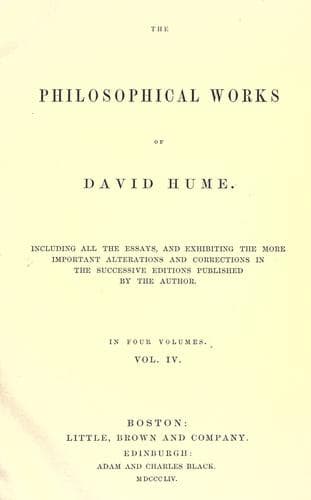
Philosophical Works, v. 1 (of 4): Including All the Essays, and Exhibiting the More Important Alterations and Corrections in the Successive Editions Published by the AuthorHume, David
PhilosophyPhilosophy
Philosophical Works, v. 1 (of 4): Including All the Essays, and Exhibiting the More Important Alterations and Corrections in the Successive Editions Published by the Author
Hume, David
Knowledge, Theory of; Philosophy, English -- 18th century
We shall afterwards see many instances of this tendency of relation
to make us ascribe an _identity_ to _different_ objects; but shall
here confine ourselves to the present subject. We find by experience,
that there is such a _constancy_ in almost all the impressions of the
senses, that their interruption produces no alteration on them, and
hinders them not from returning the same in appearance and in situation
as at their first existence. I survey the furniture of my chamber; I
shut my eyes, and afterwards open them; and find the new perceptions
to resemble perfectly those which formerly struck my senses. This
resemblance is observed in a thousand instances, and naturally connects
together our ideas of these interrupted perceptions by the strongest
relation, and conveys the mind with an easy transition from one to
another. An easy transition or passage of the imagination, along the
ideas of these different and interrupted perceptions, is almost the
same disposition of mind with that in which we consider one constant
and uninterrupted perception. 'Tis therefore very natural for us to
mistake the one for the other.[6]
The persons who entertain this opinion concerning the identity of
our resembling perceptions, are in general all the unthinking and
unphilosophical part of mankind, (that is, all of us at one time or
other), and, consequently, such as suppose their perceptions to be
their only objects, and never think of a double existence internal and
external, representing and represented. The very image which is present
to the senses is with us the real body; and 'tis to these interrupted
images we ascribe a perfect identity. But as the interruption of the
appearance seems contrary to the identity, and naturally leads us to
regard these resembling perceptions as different from each other,
we here find ourselves at a loss how to reconcile such opposite
opinions. The smooth passage of the imagination along the ideas of the
resembling perceptions makes us ascribe to them a perfect identity. The
interrupted manner of their appearance makes us consider them as so
many resembling, but still distinct beings, which appear after certain
intervals. The perplexity arising from this contradiction produces
a propension to unite these broken appearances by the fiction of a
continued existence, which is the _third_ part of that hypothesis I
proposed to explain.
Public-domain text, read in full here on John Shaqi.
Reviews
Reviews
No reviews yet
Be the first to share your thoughts on this work.
Elsewhere in the archive
Join the Discussion
Join the discussion
Sign in to leave a comment or review.
Sign InorCreate an account