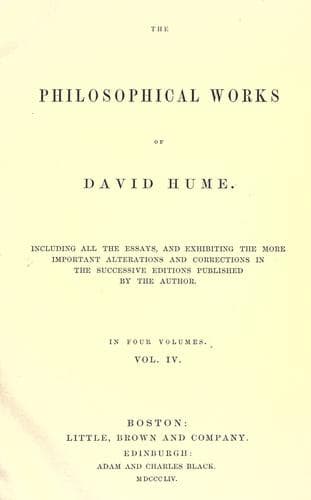
Philosophical Works, v. 1 (of 4): Including All the Essays, and Exhibiting the More Important Alterations and Corrections in the Successive Editions Published by the AuthorHume, David
PhilosophyPhilosophy
Philosophical Works, v. 1 (of 4): Including All the Essays, and Exhibiting the More Important Alterations and Corrections in the Successive Editions Published by the Author
Hume, David
Knowledge, Theory of; Philosophy, English -- 18th century
Nothing is more certain from experience than that any contradiction
either to the sentiments or passions gives a sensible uneasiness,
whether it proceeds from without or from within; from the opposition
of external objects, or from the combat of internal principles. On
the contrary, whatever strikes in with the natural propensities, and
either externally forwards their satisfaction, or internally concurs
with their movements, is sure to give a sensible pleasure. Now, there
being here an opposition betwixt the notion of the identity of
resembling perceptions, and the interruption of their appearance, the
mind must be uneasy in that situation, and will naturally seek relief
from the uneasiness. Since the uneasiness arises from the opposition
of two contrary principles, it must look for relief by sacrificing
the one to the other. But as the smooth passage of our thought along
our resembling perceptions makes us ascribe to them an identity,
we can never, without reluctance, yield up that opinion. We must
therefore turn to the other side, and suppose that our perceptions
are no longer interrupted, but preserve a continued as well as an
invariable existence, and are by that means entirely the same. But
here the interruptions in the appearance of these perceptions are so
long and frequent, that 'tis impossible to overlook them; and as the
_appearance_ of a perception in the mind and its _existence_ seem
at first sight entirely the same, it may be doubted whether we can
ever assent to so palpable a contradiction, and suppose a perception
to exist without being present to the mind. In order to clear up
this matter, and learn how the interruption in the appearance of a
perception implies not necessarily an interruption in its existence,
'twill be proper to touch upon some principles which we shall have
occasion to explain more fully afterwards.[7]
Public-domain text, read in full here on John Shaqi.
Reviews
Reviews
No reviews yet
Be the first to share your thoughts on this work.
Elsewhere in the archive
Join the Discussion
Join the discussion
Sign in to leave a comment or review.
Sign InorCreate an account