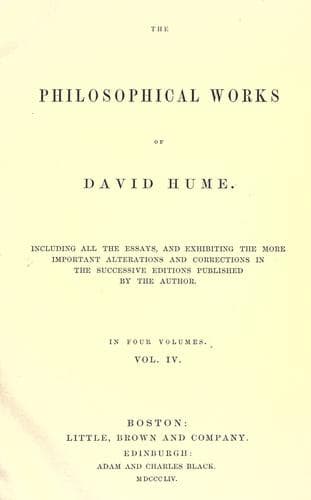
Philosophical Works, v. 1 (of 4): Including All the Essays, and Exhibiting the More Important Alterations and Corrections in the Successive Editions Published by the AuthorHume, David
PhilosophyPhilosophy
Philosophical Works, v. 1 (of 4): Including All the Essays, and Exhibiting the More Important Alterations and Corrections in the Successive Editions Published by the Author
Hume, David
Knowledge, Theory of; Philosophy, English -- 18th century
The same reasoning affords us an answer to the second question. If the
name of _perception_ renders not this separation from a mind absurd
and contradictory, the name of _object_, standing for the same thing,
can never render their conjunction impossible. External objects are
seen and felt, and become present to the mind; that is, they acquire
such a relation to a connected heap of perceptions as to influence them
very considerably in augmenting their number by present reflections
and passions, and in storing the memory with ideas. The same continued
and uninterrupted being may, therefore, be sometimes present to the
mind and sometimes absent from it without any real or essential change
in the being itself. An interrupted appearance to the senses implies
not necessarily an interruption in the existence. The supposition of
the continued existence of sensible objects or perceptions involves
no contradiction. We may easily indulge our inclination to that
supposition. When the exact resemblance of our perceptions makes us
ascribe to them an identity, we may remove the seeming interruption
by feigning a continued being, which may fill those intervals, and
preserve a perfect and entire identity to our perceptions.
But as we here not only _feign_ but _believe_ this continued existence,
the question is, _from whence arises such a belief_? and this question
leads us to the _fourth_ member of this system. It has been proved
already, that belief, in general, consists in nothing but the vivacity
of an idea; and that an idea may acquire this vivacity by its relation
to some present impression. Impressions are naturally the most vivid
perceptions of the mind; and this quality is in part conveyed by the
relation to every connected idea. The relation causes a smooth passage
from the impression to the idea, and even gives a propensity to that
passage. The mind falls so easily from the one perception to the other,
that it scarce perceives the change, but retains in the second a
considerable share of the vivacity of the first. It is excited by the
lively impression, and this vivacity is conveyed to the related idea,
without any great diminution in the passage, by reason of the smooth
transition and the propensity of the imagination.
Public-domain text, read in full here on John Shaqi.
Reviews
Reviews
No reviews yet
Be the first to share your thoughts on this work.
Elsewhere in the archive
Join the Discussion
Join the discussion
Sign in to leave a comment or review.
Sign InorCreate an account