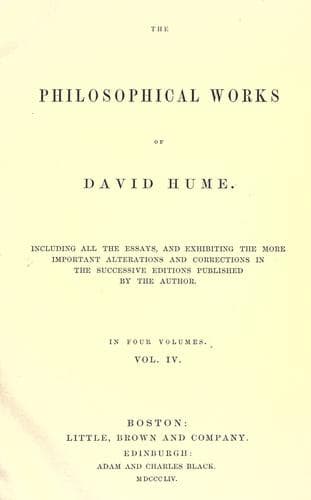
Philosophical Works, v. 1 (of 4): Including All the Essays, and Exhibiting the More Important Alterations and Corrections in the Successive Editions Published by the AuthorHume, David
PhilosophyPhilosophy
Philosophical Works, v. 1 (of 4): Including All the Essays, and Exhibiting the More Important Alterations and Corrections in the Successive Editions Published by the Author
Hume, David
Knowledge, Theory of; Philosophy, English -- 18th century
But suppose that this propensity arises from some other principle,
besides that of relation; 'tis evident, it must still have the same
effect, and convey the vivacity from the impression to the idea. Now,
this is exactly the present case. Our memory presents us with a vast
number of instances of perceptions perfectly resembling each other,
that return at different distances of time, and after considerable
interruptions. This resemblance gives us a propension to consider these
interrupted perceptions as the same; and also a propension to connect
them by a continued existence, in order to justify this identity, and
avoid the contradiction in which the interrupted appearance of these
perceptions seems necessarily to involve us. Here then we have a
propensity to feign the continued existence of all sensible objects;
and as this propensity arises from some lively impressions of the
memory, it bestows a vivacity on that fiction; or, in other words,
makes us believe the continued existence of body. If, sometimes we
ascribe a continued existence to objects, which are perfectly new to
us, and of whose constancy and coherence we have no experience, 'tis
because the manner, in which they present themselves to our senses,
resembles that of constant and coherent objects; and this resemblance
is a source of reasoning and analogy, and leads us to attribute the
same qualities to the similar objects.
I believe an intelligent reader will find less difficulty to assent
to this system, than to comprehend it fully and distinctly, and will
allow, after a little reflection, that every part carries its own proof
along with it. 'Tis indeed evident, that as the vulgar _suppose_ their
perceptions to be their only objects, and at the same time _believe_
the continued existence of matter, we must account for the origin of
the belief upon that supposition. Now, upon that supposition, 'tis a
false opinion that any of our objects, or perceptions, are identically
the same after an interruption; and consequently the opinion of
their identity can never arise from reason, but must arise from the
imagination. The imagination is seduced into such an opinion only by
means of the resemblance of certain perceptions; since we find they are
only our resembling perceptions, which we have a propension to suppose
the same. This propension to bestow an identity on our resembling
perceptions, produces the fiction of a continued existence; since that
fiction, as well as the identity, is really false, as is acknowledged
by all philosophers, and has no other effect than to remedy the
interruption of our perceptions, which is the only circumstance that
is contrary to their identity. In the last place, this propension
causes belief by means of the present impressions of the memory; since,
without the remembrance of former sensations, 'tis plain we never
should have any belief of the continued existence of body. Thus, in
examining all these parts, we find that each of them is supported by
Public-domain text, read in full here on John Shaqi.
Reviews
Reviews
No reviews yet
Be the first to share your thoughts on this work.
Elsewhere in the archive
Join the Discussion
Join the discussion
Sign in to leave a comment or review.
Sign InorCreate an account