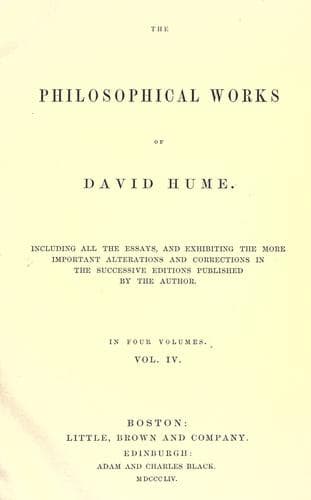
Philosophical Works, v. 1 (of 4): Including All the Essays, and Exhibiting the More Important Alterations and Corrections in the Successive Editions Published by the AuthorHume, David
PhilosophyPhilosophy
Philosophical Works, v. 1 (of 4): Including All the Essays, and Exhibiting the More Important Alterations and Corrections in the Successive Editions Published by the Author
Hume, David
Knowledge, Theory of; Philosophy, English -- 18th century
But as Nature seems to have observed a kind of justice and compensation
in every thing, she has not neglected philosophers more than the rest
of the creation, but has reserved them a consolation amid all their
disappointments and afflictions. This consolation principally consists
in their invention of the words _faculty_ and _occult quality_. For
it being usual, after the frequent use of terms, which are really
significant and intelligible, to omit the idea which we would express
by them, and preserve only the custom by which we recal the idea at
pleasure; so it naturally happens, that after the frequent use of
terms which are wholly insignificant and unintelligible, we fancy them
to be on the same footing with the precedent, and to have a secret
meaning which we might discover by reflection. The resemblance of their
appearance deceives the mind, as is usual, and makes us imagine a
thorough resemblance and conformity. By this means these philosophers
set themselves at ease, and arrive at last, by an illusion, at the
same indifference which the people attain by their stupidity, and true
philosophers by their moderate scepticism. They need only say, that
any phenomenon which puzzles them arises from a faculty or an occult
quality, and there is an end of all dispute and inquiry upon the matter.
But among all the instances wherein the Peripatetics have shown they
were guided by every trivial propensity of the imagination, no one is
more remarkable than their _sympathies, antipathies, and horrors of
a vacuum_. There is a very remarkable inclination in human nature to
bestow on external objects the same emotions which it observes in
itself, and to find every where those ideas which are most present to
it. This inclination, 'tis true, is suppressed by a little reflection,
and only takes place in children, poets, and the ancient philosophers.
It appears in children, by their desire of beating the stones which
hurt them: in poets by their readiness to personify every thing; and in
the ancient philosophers, by these fictions of sympathy and antipathy.
We must pardon children, because of their age; poets, because they
profess to follow implicitly the suggestions of their fancy; but
what excuse shall we find to justify our philosophers in so signal a
weakness?
SECTION IV.
OF THE MODERN PHILOSOPHY.
Public-domain text, read in full here on John Shaqi.
Reviews
Reviews
No reviews yet
Be the first to share your thoughts on this work.
Elsewhere in the archive
Join the Discussion
Join the discussion
Sign in to leave a comment or review.
Sign InorCreate an account