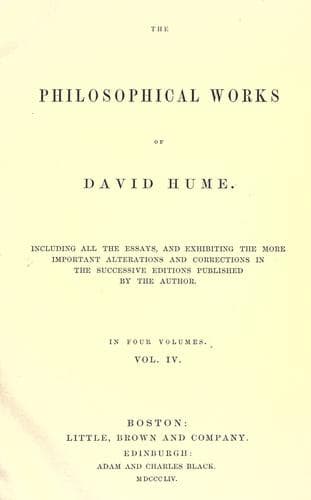
Philosophical Works, v. 1 (of 4): Including All the Essays, and Exhibiting the More Important Alterations and Corrections in the Successive Editions Published by the AuthorHume, David
PhilosophyPhilosophy
Philosophical Works, v. 1 (of 4): Including All the Essays, and Exhibiting the More Important Alterations and Corrections in the Successive Editions Published by the Author
Hume, David
Knowledge, Theory of; Philosophy, English -- 18th century
But here it may be objected, that the imagination, according to my own
confession, being the ultimate judge of all systems of philosophy, I
am unjust in blaming the ancient philosophers for making use of that
faculty, and allowing themselves to be entirely guided by it in their
reasonings. In order to justify myself, I must distinguish in the
imagination betwixt the principles which are permanent, irresistible,
and universal; such as the customary transition from causes to effects,
and from effects to causes: and the principles, which are changeable,
weak and irregular; such as those I have just now taken notice of. The
former are the foundation of all our thoughts and actions, so that
upon their removal, human nature must immediately perish and go to
ruin. The latter are neither unavoidable to mankind, nor necessary, or
so much as useful in the conduct of life; but, on the contrary, are
observed only to take place in weak minds, and being opposite to the
other principles of custom and reasoning, may easily be subverted by a
due contrast and opposition. For this reason, the former are received
by philosophy, and the latter rejected. One who concludes somebody to
be near him, when he hears an articulate voice in the dark, reasons
justly and naturally; though that conclusion be derived from nothing
but custom, which infixes and enlivens the idea of a human creature, on
account of his usual conjunction with the present impression. But one,
who is tormented he knows not why, with the apprehension of spectres
in the dark, may perhaps be said to reason, and to reason naturally
too: but then it must be in the same sense that a malady is said to
be natural; as arising from natural causes, though it be contrary to
health, the most agreeable and most natural situation of man.
The opinions of the ancient philosophers, their fictions of substance
and accident, and their reasonings concerning substantial forms and
occult qualities, are like the spectres in the dark, and are derived
from principles, which, however common, are neither universal nor
unavoidable in human nature. The _modern philosophy_ pretends to be
entirely free from this defect, and to arise only from the solid,
permanent, and consistent principles of the imagination. Upon what
grounds this pretension is founded, must now be the subject of our
inquiry.
Public-domain text, read in full here on John Shaqi.
Reviews
Reviews
No reviews yet
Be the first to share your thoughts on this work.
Elsewhere in the archive
Join the Discussion
Join the discussion
Sign in to leave a comment or review.
Sign InorCreate an account