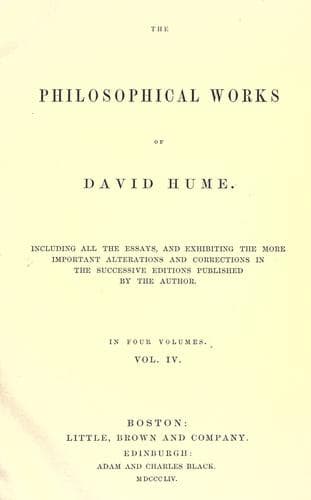
Philosophical Works, v. 1 (of 4): Including All the Essays, and Exhibiting the More Important Alterations and Corrections in the Successive Editions Published by the AuthorHume, David
PhilosophyPhilosophy
Philosophical Works, v. 1 (of 4): Including All the Essays, and Exhibiting the More Important Alterations and Corrections in the Successive Editions Published by the Author
Hume, David
Knowledge, Theory of; Philosophy, English -- 18th century
This principle being once admitted, all the other doctrines of that
philosophy seem to follow by an easy consequence. For, upon the removal
of sounds, colours, heat, cold, and other sensible qualities, from the
rank of continued independent existences, we are reduced merely to
what are called primary qualities, as the only _real_ ones, of which
we have any adequate notion. These primary qualities are extension and
solidity, with their different mixtures and modifications; figure,
motion, gravity and cohesion. The generation, increase, decay and
corruption of animals and vegetables, are nothing but changes of figure
and motion; as also the operations of all bodies on each other; of
fire, of light, water, air, earth, and of all the elements and powers
of nature. One figure and motion produces another figure and motion;
nor does there remain in the material universe any other principle,
either active or passive, of which we can form the most distant idea.
I believe many objections might be made to this system; but at present
I shall confine myself to one, which is, in my opinion, very decisive.
I assert, that instead of explaining the operations of external objects
by its means, we utterly annihilate all these objects, and reduce
ourselves to the opinions of the most extravagant scepticism concerning
them. If colours, sounds, tastes and smells be merely perceptions,
nothing, we can conceive, is possessed of a real, continued, and
independent existence; not even motion, extension and solidity, which
are the primary qualities chiefly insisted on.
To begin with the examination of motion; 'tis evident this is a quality
altogether inconceivable alone, and without a reference to some other
object. The idea of motion necessarily supposes that of a body moving.
Now, what is our idea of the moving body, without which motion is
incomprehensible? It must resolve itself into the idea of extension or
of solidity; and consequently the reality of motion depends upon that
of these other qualities.
This opinion, which is universally acknowledged concerning motion, I
have proved to be true with regard to extension; and have shown that
'tis impossible to conceive extension but as composed of parts, endowed
with colour or solidity. The idea of extension is a compound idea; but
as it is not compounded of an infinite number of parts or inferior
ideas, it must at last resolve itself into such as are perfectly simple
and indivisible. These simple and indivisible parts not being ideas of
extension, must be nonentities, unless conceived as coloured or solid.
Colour is excluded from any real existence. The reality therefore of
our idea of extension depends upon the reality of that of solidity; nor
can the former be just while the latter is chimerical. Let us then lend
our attention to the examination of the idea of solidity.
Public-domain text, read in full here on John Shaqi.
Reviews
Reviews
No reviews yet
Be the first to share your thoughts on this work.
Elsewhere in the archive
Join the Discussion
Join the discussion
Sign in to leave a comment or review.
Sign InorCreate an account