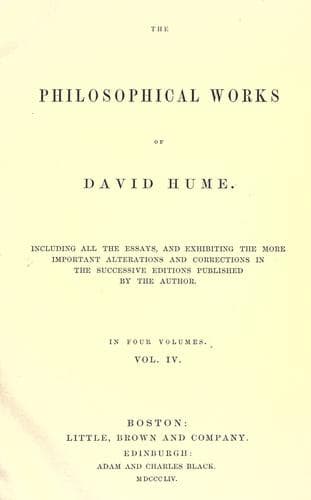
Philosophical Works, v. 1 (of 4): Including All the Essays, and Exhibiting the More Important Alterations and Corrections in the Successive Editions Published by the AuthorHume, David
PhilosophyPhilosophy
Philosophical Works, v. 1 (of 4): Including All the Essays, and Exhibiting the More Important Alterations and Corrections in the Successive Editions Published by the Author
Hume, David
Knowledge, Theory of; Philosophy, English -- 18th century
The fundamental principle of that philosophy is the opinion concerning
colours, sounds, tastes, smells, heat and cold; which it asserts to
be nothing but impressions in the mind, derived from the operation
of external objects, and without any resemblance to the qualities of
the objects. Upon examination, I find only one of the reasons commonly
produced for this opinion to be satisfactory; viz. that derived from
the variations of those impressions, even while the external object,
to all appearance, continues the same. These variations depend upon
several circumstances. Upon the different situations of our health:
a man in a malady feels a disagreeable taste in meats, which before
pleased him the most. Upon the different complexions and constitutions
of men: that seems bitter to one, which is sweet to another. Upon the
difference of their external situation and position: colours reflected
from the clouds change according to the distance of the clouds, and
according to the angle they make with the eye and luminous body. Fire
also communicates the sensation of pleasure at one distance, and that
of pain at another. Instances of this kind are very numerous and
frequent.
The conclusion drawn from them, is likewise as satisfactory as can
possibly be imagined. 'Tis certain, that when different impressions of
the same sense arise from any object, every one of these impressions
has not a resembling quality existent in the object. For as the same
object cannot, at the same time, be endowed with different qualities
of the same sense, and as the same quality cannot resemble impressions
entirely different; it evidently follows, that many of our impressions
have no external model or archetype. Now, from like effects we
presume like causes. Many of the impressions of colour, sound, &c.,
are confessed to be nothing but internal existences, and to arise
from causes, which no ways resemble them. These impressions are in
appearance nothing different from the other impressions of colour,
sound, &c. We conclude, therefore, that they are, all of them, derived
from a like origin.
Public-domain text, read in full here on John Shaqi.
Reviews
Reviews
No reviews yet
Be the first to share your thoughts on this work.
Elsewhere in the archive
Join the Discussion
Join the discussion
Sign in to leave a comment or review.
Sign InorCreate an account