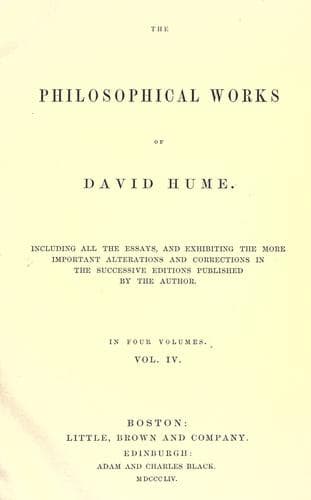
Philosophical Works, v. 1 (of 4): Including All the Essays, and Exhibiting the More Important Alterations and Corrections in the Successive Editions Published by the AuthorHume, David
PhilosophyPhilosophy
Philosophical Works, v. 1 (of 4): Including All the Essays, and Exhibiting the More Important Alterations and Corrections in the Successive Editions Published by the Author
Hume, David
Knowledge, Theory of; Philosophy, English -- 18th century
But leaving the question of _what may or may not be_, for that other
_what actually is_, I desire those philosophers, who pretend that we
have an idea of the substance of our minds, to point out the impression
that produces it, and tell distinctly after what manner that impression
operates, and from what object it is derived. Is it an impression of
sensation or reflection? Is it pleasant, or painful, or indifferent?
Does it attend us at all times, or does it only return at intervals?
If at intervals, at what times principally does it return, and by what
causes is it produced?
If, instead of answering these questions, any one should evade
the difficulty, by saying, that the definition of a substance is
_something which may exist by itself_, and that this definition ought
to satisfy us: should this be said, I should observe, that this
definition agrees to every thing that can possibly be conceived;
and never will serve to distinguish substance from accident, or the
soul from its perceptions. For thus I reason. Whatever is clearly
conceived, may exist; and whatever is clearly conceived, after any
manner, may exist after the same manner. This is one principle which
has been already acknowledged. Again, every thing which is different is
distinguishable, and every thing which is distinguishable is separable
by the imagination. This is another principle. My conclusion from both
is, that since all our perceptions are different from each other,
and from every thing else in the universe, they are also distinct
and separable, and may be considered as separately existent, and may
exist separately, and have no need of any thing else to support their
existence. They are therefore substances, as far as this definition
explains a substance.
Thus, neither by considering the first origin of ideas, nor by means
of a definition, are we able to arrive at any satisfactory notion
of substance, which seems to me a sufficient reason for abandoning
utterly that dispute concerning the materiality and immateriality of
the soul, and makes me absolutely condemn even the question itself. We
have no perfect idea of any thing but of a perception. A substance is
entirely different from a perception. We have therefore no idea of a
substance. Inhesion in something is supposed to be requisite to support
the existence of our perceptions. Nothing appears requisite to support
the existence of a perception. We have therefore no idea of inhesion.
What possibility then of answering that question, _Whether perceptions
inhere in a material or immaterial substance_, when we do not so much
as understand the meaning of the question?
Public-domain text, read in full here on John Shaqi.
Reviews
Reviews
No reviews yet
Be the first to share your thoughts on this work.
Elsewhere in the archive
Join the Discussion
Join the discussion
Sign in to leave a comment or review.
Sign InorCreate an account