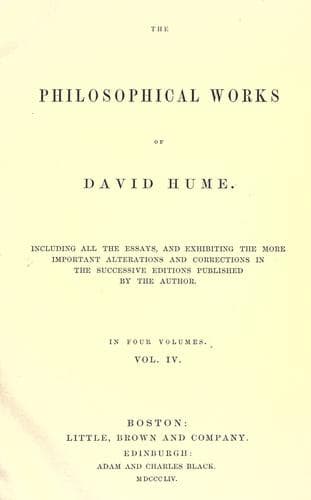
Philosophical Works, v. 1 (of 4): Including All the Essays, and Exhibiting the More Important Alterations and Corrections in the Successive Editions Published by the AuthorHume, David
PhilosophyPhilosophy
Philosophical Works, v. 1 (of 4): Including All the Essays, and Exhibiting the More Important Alterations and Corrections in the Successive Editions Published by the Author
Hume, David
Knowledge, Theory of; Philosophy, English -- 18th century
There is one argument commonly employed for the immateriality of the
soul, which seems to me remarkable. Whatever is extended consists
of parts; and whatever consists of parts is divisible, if not in
reality, at least in the imagination. But 'tis impossible any thing
divisible can be _conjoined_ to a thought or perception, which is a
being altogether inseparable and indivisible. For, supposing such a
conjunction, would the indivisible thought exist on the left or on
the right hand of this extended divisible body? On the surface or in
the middle? On the back or fore-side of it? If it be conjoined with
the extension, it must exist somewhere within its dimensions. If it
exist within its dimensions, it must either exist in one particular
part; and then that particular part is indivisible, and the perception
is conjoined only with it, not with the extension: or if the thought
exists in every part, it must also be extended, and separable,
and divisible, as well as the body, which is utterly absurd and
contradictory. For can any one conceive a passion of a yard in length,
a foot in breadth, and an inch in thickness? Thought therefore and
extension are qualities wholly incompatible, and never can incorporate
together into one subject.
This argument affects not the question concerning the _substance_ of
the soul, but only that concerning its _local conjunction_ with matter;
and therefore it may not be improper to consider in general what
objects are, or are not susceptible of a local conjunction. This is a
curious question, and may lead us to some discoveries of considerable
moment.
The first notion of space and extension is derived solely from the
senses of sight and feeling; nor is there anything, but what is
coloured or tangible, that has parts disposed after such a manner
as to convey that idea. When we diminish or increase a relish, 'tis
not after the same manner that we diminish or increase any visible
object; and when several sounds strike our hearing at once, custom and
reflection alone make us form an idea of the degrees of the distance
and contiguity of those bodies from which they are derived. Whatever
marks the place of its existence, either must be extended, or must be a
mathematical point, without parts or composition. What is extended must
have a particular figure, as square, round, triangular; none of which
will agree to a desire, or indeed to any impression or idea, except
of these two senses above-mentioned. Neither ought a desire, though
indivisible, to be considered as a mathematical point. For in that case
'twould be possible, by the addition of others, to make two, three,
four desires; and these disposed and situated in such a manner, as to
have a determinate length, breadth, and thickness; which is evidently
absurd.
Public-domain text, read in full here on John Shaqi.
Reviews
Reviews
No reviews yet
Be the first to share your thoughts on this work.
Elsewhere in the archive
Join the Discussion
Join the discussion
Sign in to leave a comment or review.
Sign InorCreate an account