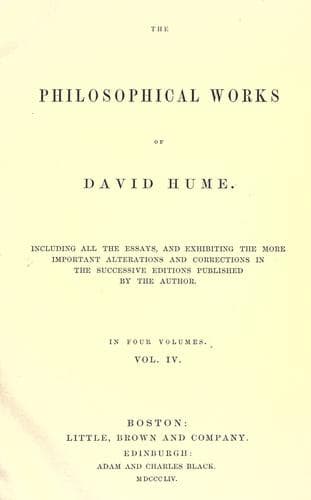
Philosophical Works, v. 1 (of 4): Including All the Essays, and Exhibiting the More Important Alterations and Corrections in the Successive Editions Published by the AuthorHume, David
PhilosophyPhilosophy
Philosophical Works, v. 1 (of 4): Including All the Essays, and Exhibiting the More Important Alterations and Corrections in the Successive Editions Published by the Author
Hume, David
Knowledge, Theory of; Philosophy, English -- 18th century
'Twill not be surprising after this, if I deliver a maxim, which is
condemned by several metaphysicians, and is esteemed contrary to the
most certain principles of human reason. This maxim is, _that an object
may exist, and yet be no where_: and I assert, that this is not only
possible, but that the greatest part of beings do and must exist after
this manner. An object may be said to be no where, when its parts are
not so situated with respect to each other, as to form any figure or
quantity; nor the whole with respect to other bodies so as to answer
to our notions of contiguity or distance. Now, this is evidently the
case with all our perceptions and objects, except those of the sight
and feeling. A moral reflection cannot be placed on the right or on
the left hand of a passion; nor can a smell or sound be either of a
circular or a square figure.
These objects and perceptions, so far from requiring any particular
place, are absolutely incompatible with it, and even the imagination
cannot attribute it to them. And as to the absurdity of supposing them
to be no where, we may consider, that if the passions and sentiments
appear to the perception to have any particular place, the idea of
extension might be derived from them, as well as from the sight and
touch; contrary to what we have already established. If they _appear_
not to have any particular place, they may possibly _exist_ in the same
manner; since whatever we conceive is possible.
'Twill not now be necessary to prove, that those perceptions, which
are simple, and exist no where, are incapable of any conjunction in
place with matter or body, which is extended and divisible; since 'tis
impossible to found a relation but on some common quality.[9] It may
be better worth our while to remark, that this question of the local
conjunction of objects, does not only occur in metaphysical disputes
concerning the nature of the soul, but that even in common life we have
every moment occasion to examine it. Thus, supposing we consider a
fig at one end of the table, and an olive at the other, 'tis evident,
that, in forming the complex ideas of these substances, one of the most
obvious is that of their different relishes; and 'tis as evident, that
we incorporate and conjoin these qualities with such as are coloured
and tangible. The bitter taste of the one, and sweet of the other, are
supposed to lie in the very visible body, and to be separated from
each other by the whole length of the table. This is so notable and so
natural an illusion, that it may be proper to consider the principles
from which it is derived.
Public-domain text, read in full here on John Shaqi.
Reviews
Reviews
No reviews yet
Be the first to share your thoughts on this work.
Elsewhere in the archive
Join the Discussion
Join the discussion
Sign in to leave a comment or review.
Sign InorCreate an account