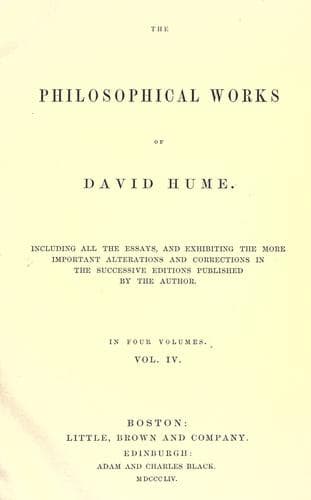
Philosophical Works, v. 1 (of 4): Including All the Essays, and Exhibiting the More Important Alterations and Corrections in the Successive Editions Published by the AuthorHume, David
PhilosophyPhilosophy
Philosophical Works, v. 1 (of 4): Including All the Essays, and Exhibiting the More Important Alterations and Corrections in the Successive Editions Published by the Author
Hume, David
Knowledge, Theory of; Philosophy, English -- 18th century
It is not true in any sense that I agreed to accept of
a model from Mr Gosset as a present. On the contrary, I
asked him the price, which he told me was a guinea and
half, adding that he intended to present me with it; an
offer I did not accept. I desire you therefore to pay him
for it, and Mr Davenport will be so good as repay you the
money. And if Mr Gosset does not consent to be paid for it,
it must be returned to him, and purchased by some other
hand. It is designed for Mr du Peyrou, who desired long
since to have my portrait, and caused one to be painted
in miniature, which is not at all like me. You were more
fortunate in this respect than me; but I am sorry that, by
your assiduity to serve me, you deprived me of the pleasure
of discharging the same friendly obligation with regard to
yourself. Be so good, my dear patron, as to order the model
to be sent to Messrs Guinand and Hankey, Little St Helen's,
Bishopsgate Street, in order to be transmitted to Mr du
Peyrou by the first safe conveyance. It hath been a frost
ever since I have been here; the snow falls daily; and the
wind is cutting and severe; notwithstanding all which, I
had rather lodge in the hollow trunk of an old tree, in
this country, than in the most superb apartment in London.
Good day, my dear patron. I embrace you with all my heart.
J. J. R.
Mr Rousseau and I having agreed not to lay each other under any
restraint by a continued correspondence, the only subject of our future
letters was the obtaining a pension for him from the King of England,
which was then in agitation, and of which affair the following is a
concise and faithful relation.
As we were conversing together one evening at Calais, where we were
detained by contrary winds, I asked Mr Rousseau if he would not accept
of a pension from the King of England, in case his Majesty should be
pleased to grant him one. To this he replied, it was a matter of some
difficulty to resolve on, but that he should be entirely directed
by the advice of my Lord Marshall. Encouraged by this answer, I no
sooner arrived in London than I addressed myself to his Majesty's
Ministers, and particularly to General Conway, Secretary of State, and
General Græme, Secretary and Chamberlain to the Queen. Application was
accordingly made to their Majesties, who, with their usual goodness,
consented, on condition only that the affair should not be made public.
Mr Rousseau and I both wrote to my Lord Marshall; and Mr Rousseau
expressly observed in his letter, that the circumstance of the affair's
being to be kept secret was very agreeable to him. The consent of my
Lord Marshall arrived, as may readily be imagined; soon after which Mr
Rousseau set out for Wooton, while the business remained some time in
suspense, on account of the indisposition of General Conway.
Public-domain text, read in full here on John Shaqi.
Reviews
Reviews
No reviews yet
Be the first to share your thoughts on this work.
Join the Discussion
Join the discussion
Sign in to leave a comment or review.
Sign InorCreate an account