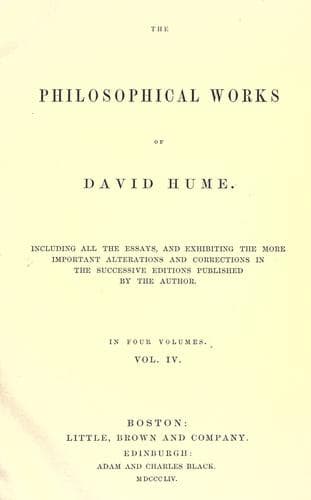
Philosophical Works, v. 1 (of 4): Including All the Essays, and Exhibiting the More Important Alterations and Corrections in the Successive Editions Published by the AuthorHume, David
PhilosophyPhilosophy
Philosophical Works, v. 1 (of 4): Including All the Essays, and Exhibiting the More Important Alterations and Corrections in the Successive Editions Published by the Author
Hume, David
Knowledge, Theory of; Philosophy, English -- 18th century
But whatever confused notions we may form of an union in place betwixt
an extended body, as a fig, and its particular taste, 'tis certain
that, upon reflection, we must observe in this union something
altogether unintelligible and contradictory. For, should we ask
ourselves one obvious question, viz. if the taste, which we conceive to
be contained in the circumference of the body, is in every part of it,
or in one only, we must quickly find ourselves at a loss, and perceive
the impossibility of ever giving a satisfactory answer. We cannot reply
that 'tis only in one part: for experience convinces us that every part
has the same relish. We can as little reply that it exists in every
part: for then we must suppose it figured and extended; which is absurd
and incomprehensible. Here, then, we are influenced by two principles,
directly contrary to each other, viz. that _inclination_ of our fancy
by which we are determined to incorporate the taste with the extended
object, and our _reason_, which shows us the impossibility of such an
union. Being divided betwixt these opposite principles, we renounce
neither one nor the other, but involve the subject in such confusion
and obscurity, that we no longer perceive the opposition. We suppose
that the taste exists within the circumference of the body, but in
such a manner, that it fills the whole without extension, and exists
entire in every part without separation. In short, we use, in our most
familiar way of thinking, that scholastic principle which, when crudely
proposed, appears so shocking, of _totum in toto, et totum in qualibet
parte_; which is much the same as if we should say, that a thing is in
a certain place, and yet is not there.
All this absurdity proceeds from our endeavouring to bestow a place on
what is utterly incapable of it; and that endeavour again arises from
our inclination to complete an union which is founded on causation and
a contiguity of time, by attributing to the objects a conjunction in
place. But if ever reason be of sufficient force to overcome prejudice,
'tis certain that, in the present case, it must prevail. For we have
only this choice left, either to suppose that some beings exist without
any place, or that they are figured and extended; or that when they
are incorporated with extended objects, the whole is in the whole, and
the whole in every part. The absurdity of the two last suppositions
proves sufficiently the veracity of the first. Nor is there any fourth
opinion: For as to the supposition of their existence in the manner of
mathematical points, it resolves itself into the second opinion, and
supposes, that several passions may be placed in a circular figure,
and that a certain number of smells, conjoined with a certain number
of sounds, may make a body of twelve cubic inches; which appears
ridiculous upon the bare mentioning of it.
Public-domain text, read in full here on John Shaqi.
Reviews
Reviews
No reviews yet
Be the first to share your thoughts on this work.
Elsewhere in the archive
Join the Discussion
Join the discussion
Sign in to leave a comment or review.
Sign InorCreate an account