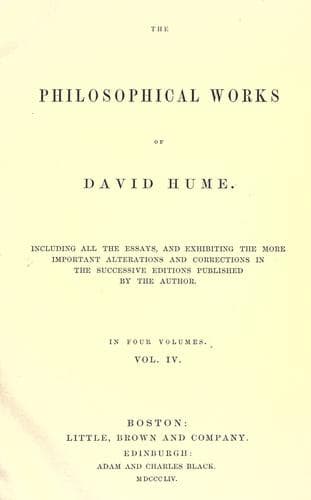
Philosophical Works, v. 1 (of 4): Including All the Essays, and Exhibiting the More Important Alterations and Corrections in the Successive Editions Published by the AuthorHume, David
PhilosophyPhilosophy
Philosophical Works, v. 1 (of 4): Including All the Essays, and Exhibiting the More Important Alterations and Corrections in the Successive Editions Published by the Author
Hume, David
Knowledge, Theory of; Philosophy, English -- 18th century
But though in this view of things we cannot refuse to condemn, the
materialists, who conjoin all thought with extension; yet a little
reflection will show us equal reason for blaming their antagonists,
who conjoin all thought with a simple and indivisible substance. The
most vulgar philosophy informs us, that no external object can make
itself known to the mind immediately, and without the interposition of
an image or perception. That table, which just now appears to me, is
only a perception, and all its qualities are qualities of a perception.
Now, the most obvious of all its qualities is extension. The perception
consists of parts. These parts are so situated as to afford us the
notion of distance and contiguity, of length, breadth and thickness.
The termination of these three dimensions is what we call figure. This
figure is moveable, separable, and divisible. Mobility and separability
are the distinguishing properties of extended objects. And to cut short
all disputes, the very idea of extension is copied from nothing but an
impression, and consequently must perfectly agree to it. To say the
idea of extension agrees to any thing, is to say it is extended.
The freethinker may now triumph in his turn; and having found there are
impressions and ideas really extended, may ask his antagonists, how
they can incorporate a simple and indivisible subject with an extended
perception? All the arguments of theologians may here be retorted
upon them. Is the indivisible subject or immaterial substance, if you
will, on the left or on the right hand of the perception? Is it in
this particular part, or in that other? Is it in every part without
being extended? Or is it entire in any one part without deserting the
rest? 'Tis impossible to give any answer to these questions but what
will both be absurd in itself, and will account for the union of our
indivisible perceptions with an extended substance.
This gives me an occasion to take anew into consideration the question
concerning the substance of the soul; and though I have condemned that
question as utterly unintelligible, yet I cannot forbear proposing some
farther reflections concerning it. I assert, that the doctrine of the
immateriality, simplicity, and indivisibility of a thinking substance
is a true atheism, and will serve to justify all those sentiments for
which Spinoza is so universally infamous. From this topic I hope at
least to reap one advantage, that my adversaries will not have any
pretext to render the present doctrine odious by their declamations
when they see that they can be so easily retorted on them.
Public-domain text, read in full here on John Shaqi.
Reviews
Reviews
No reviews yet
Be the first to share your thoughts on this work.
Elsewhere in the archive
Join the Discussion
Join the discussion
Sign in to leave a comment or review.
Sign InorCreate an account