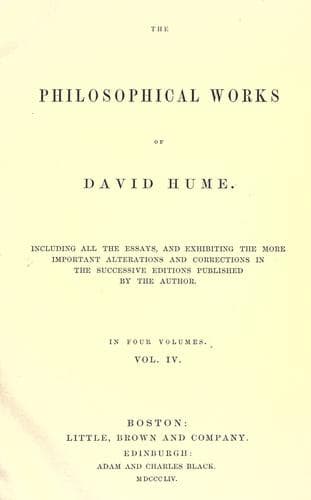
Philosophical Works, v. 1 (of 4): Including All the Essays, and Exhibiting the More Important Alterations and Corrections in the Successive Editions Published by the AuthorHume, David
PhilosophyPhilosophy
Philosophical Works, v. 1 (of 4): Including All the Essays, and Exhibiting the More Important Alterations and Corrections in the Successive Editions Published by the Author
Hume, David
Knowledge, Theory of; Philosophy, English -- 18th century
I add, in the second place, that if it brings any advantage to that
cause, it must bring an equal to the cause of atheism. For, do our
theologians pretend to make a monopoly of the word _action_, and may
not the atheists likewise take possession of it, and affirm that
other plants, animals, men, &c., are nothing but particular actions
of one simple universal substance, which exerts itself from a blind
and absolute necessity? This you'll say, is utterly absurd. I own
'tis unintelligible; but, at the same time assert, according to the
principles above explained, that 'tis impossible to discover any
absurdity in the supposition, that all the various objects in nature
are actions of one simple substance, which absurdity will not be
applicable to a like supposition concerning impressions and ideas.
From these hypotheses concerning the _substance_ and _local
conjunction_ of our perceptions, we may pass to another, which is more
intelligible than the former, and more important than the latter, viz.
concerning the _cause_ of our perceptions. Matter and motion, 'tis
commonly said in the schools, however varied, are still matter and
motion, and produce only a difference in the position and situation of
objects. Divide a body as often as you please, 'tis still body. Place
it in any figure, nothing ever results but figure, or the relation
of parts. Move it in any manner, you still find motion or a change
of relation. 'Tis absurd to imagine, that motion in a circle, for
instance, should be nothing but merely motion in a circle; while motion
in another direction, as in an ellipse, should also be a passion or
moral reflection: that the shocking of two globular particles should
become a sensation of pain, and that the meeting of two triangular ones
should afford a pleasure. Now as these different shocks and variations
and mixtures are the only changes of which matter is susceptible, and
as these never afford us any idea of thought or perception, 'tis
concluded to be impossible, that thought can ever be caused by matter.
Public-domain text, read in full here on John Shaqi.
Reviews
Reviews
No reviews yet
Be the first to share your thoughts on this work.
Elsewhere in the archive
Join the Discussion
Join the discussion
Sign in to leave a comment or review.
Sign InorCreate an account