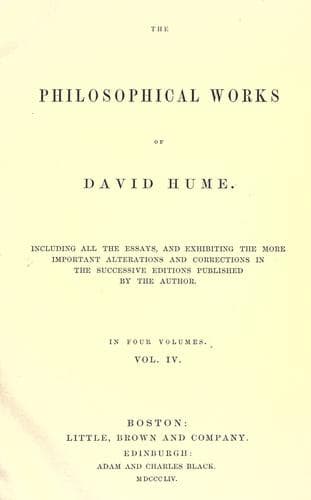
Philosophical Works, v. 1 (of 4): Including All the Essays, and Exhibiting the More Important Alterations and Corrections in the Successive Editions Published by the AuthorHume, David
PhilosophyPhilosophy
Philosophical Works, v. 1 (of 4): Including All the Essays, and Exhibiting the More Important Alterations and Corrections in the Successive Editions Published by the Author
Hume, David
Knowledge, Theory of; Philosophy, English -- 18th century
Few have been able to withstand the seeming evidence of this argument;
and yet nothing in the world is more easy than to refute it. We need
only reflect on what has been proved at large, that we are never
sensible of any connexion betwixt causes and effects, and that 'tis
only by our experience of their constant conjunction, we can arrive
at any knowledge of this relation. Now, as all objects, which are not
contrary, are susceptible of a constant conjunction, and as no real
objects are contrary; I have inferred from these principles,[14] that
to consider the matter _a priori_, any thing may produce any thing,
and that we shall never discover a reason, why any object may or may
not be the cause of any other, however great, or however little the
resemblance may be betwixt them. This evidently destroys the precedent
reasoning concerning the cause of thought or perception. For though
there appear no manner of connexion betwixt motion or thought, the
case is the same with all other causes and effects. Place one body
of a pound weight on one end of a lever, and another body of the
same weight on another end; you will never find in these bodies any
principle of motion dependent on their distances from the centre, more
than of thought and perception. If you pretend, therefore, to prove,
_a priori_, that such a position of bodies can never cause thought;
because, turn it which way you will, 'tis nothing but a position of
bodies; you must, by the same course of reasoning conclude, that it
can never produce motion; since there is no more apparent connexion
in the one case than in the other. But as this latter conclusion is
contrary to evident experience, and as 'tis possible we may have a like
experience in the operations of the mind, and may perceive a constant
conjunction of thought and motion; you reason too hastily, when, from
the mere consideration of the ideas, you conclude that 'tis impossible
motion can ever produce thought, or a different position of parts give
rise to a different passion or reflection. Nay, 'tis not only possible
we may have such an experience, but 'tis certain we have it; since
every one may perceive, that the different dispositions of his body
change his thoughts and sentiments. And should it be said, that this
depends on the union of soul and body, I would answer, that we must
separate the question concerning the substance of the mind from that
concerning the cause of its thought; and that, confining ourselves
to the latter question, we find, by the comparing their ideas, that
thought and motion are different from each other, and by experience,
that they are constantly united; which being all the circumstances that
enter into the idea of cause and effect, when applied to the operations
of matter, we may certainly conclude, that motion may be, and actually
is, the cause of thought and perception.
Public-domain text, read in full here on John Shaqi.
Reviews
Reviews
No reviews yet
Be the first to share your thoughts on this work.
Elsewhere in the archive
Join the Discussion
Join the discussion
Sign in to leave a comment or review.
Sign InorCreate an account