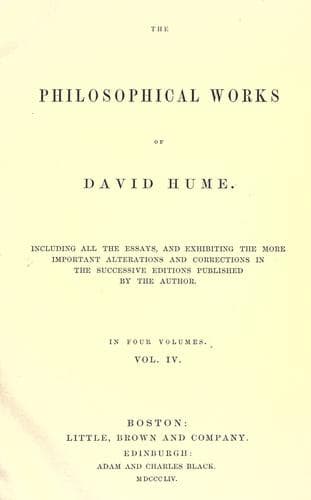
Philosophical Works, v. 1 (of 4): Including All the Essays, and Exhibiting the More Important Alterations and Corrections in the Successive Editions Published by the AuthorHume, David
PhilosophyPhilosophy
Philosophical Works, v. 1 (of 4): Including All the Essays, and Exhibiting the More Important Alterations and Corrections in the Successive Editions Published by the Author
Hume, David
Knowledge, Theory of; Philosophy, English -- 18th century
Thus we are necessarily reduced to the other side of the dilemma,
viz. that all objects, which are found to be constantly conjoined,
are upon that account only to be regarded as causes and effects. Now,
as all objects which are not contrary, are susceptible of a constant
conjunction, and as no real objects are contrary; it follows, that, for
ought we can determine by the mere ideas, any thing may be the cause
or effect of any thing; which evidently gives the advantage to the
materialists above their antagonists.
To pronounce, then, the final decision upon the whole: the question
concerning the substance of the soul is absolutely unintelligible:
all our perceptions are not susceptible of a local union, either with
what is extended or unextended; there being some of them of the one
kind, and some of the other: and as the constant conjunction of objects
constitutes the very essence of cause and effect, matter and motion
may often be regarded as the causes of thought, as far as we have any
notion of that relation.
'Tis certainly a kind of indignity to philosophy, whose sovereign
authority ought every where to be acknowledged, to oblige her on every
occasion to make apologies for her conclusions, and justify herself
to every particular art and science, which may be offended at her.
This puts one in mind of a king arraigned for high treason against
his subjects. There is only one occasion when philosophy will think
it necessary and even honourable to justify herself; and that is,
religion may seem to be in the least offended; whose rights are as dear
to her as her own, and are indeed the same. If any one, therefore,
should imagine that the foregoing arguments are any ways dangerous to
religion, I hope the following apology will remove his apprehensions.
There is no foundation for any conclusion _a priori_, either concerning
the operations or duration of any object, of which 'tis possible for
the human mind to form a conception. Any object may be imagined to
become entirely inactive, or to be annihilated in a moment; and 'tis
an evident principle, _that whatever we can imagine is possible_.
Now this is no more true of matter, than of spirit; of an extended
compounded substance, than of a simple and unextended. In both cases
the metaphysical arguments for the immortality of the soul are equally
inconclusive; and in both cases the moral arguments and those derived
from the analogy of nature are equally strong and convincing. If my
philosophy therefore makes no addition to the arguments for religion, I
have at least the satisfaction to think it takes nothing from them, but
that every thing remains precisely as before.
[9] Part I. Sect. 5.
[10] Sect 2, towards the end.
[11] Part. II. Sect. 6.
[12] Such as that of Sect. 2, from the coherence of our perceptions.
[13] See Bayle's Dictionary, article of Spinoza.
[14] Part III. sect. 15.
[15] As Father Malebranche and other Cartesians.
SECTION VI.
OF PERSONAL IDENTITY.
Public-domain text, read in full here on John Shaqi.
Reviews
Reviews
No reviews yet
Be the first to share your thoughts on this work.
Elsewhere in the archive
Join the Discussion
Join the discussion
Sign in to leave a comment or review.
Sign InorCreate an account