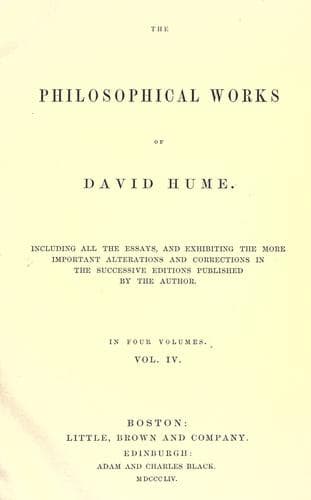
Philosophical Works, v. 1 (of 4): Including All the Essays, and Exhibiting the More Important Alterations and Corrections in the Successive Editions Published by the AuthorHume, David
PhilosophyPhilosophy
Philosophical Works, v. 1 (of 4): Including All the Essays, and Exhibiting the More Important Alterations and Corrections in the Successive Editions Published by the Author
Hume, David
Knowledge, Theory of; Philosophy, English -- 18th century
There seems only this dilemma left us in the present case; either to
assert, that nothing can be the cause of another, but where the mind
can perceive the connexion in its idea of the objects: or to maintain,
that all objects which we find constantly conjoined, are upon that
account to be regarded as causes and effects. If we choose the first
part of the dilemma, these are the consequences. _First_, we in reality
affirm, that there is no such thing in the universe as a cause or
productive principle, not even the Deity himself; since our idea of
that Supreme Being is derived from particular impressions, none of
which contain any efficacy, nor seem to have _any_ connexion with _any_
other existence. As to what may be said, that the connexion betwixt the
idea of an infinitely powerful Being and that of any effect, which he
wills, is necessary and unavoidable; I answer, that we have no idea of
a Being endowed with any power, much less of one endowed with infinite
power. But if we will change expressions, we can only define power by
connexion; and then in saying, that the idea of an infinitely powerful
Being is connected with that of every effect which he wills, we really
do no more than assert, that a Being, whose volition is connected with
every effect, is connected with every effect; which is an identical
proposition, and gives us no insight into the nature of this power or
connexion. But, _secondly_, supposing that the Deity were the great and
efficacious principle which supplies the deficiency of all causes, this
leads us into the grossest impieties and absurdities. For upon the same
account that we have recourse to him in natural operations, and assert
that matter cannot of itself communicate motion, or produce thought,
viz. because there is no apparent connexion betwixt these objects; I
say, upon the very same account, we must acknowledge that the Deity
is the author of all our volitions and perceptions; since they have
no more apparent connexion either with one another, or with the
supposed but unknown substance of the soul. This agency of the Supreme
Being we know to have been asserted by several philosophers[15] with
relation to all the actions of the mind, except volition, or rather
an inconsiderable part of volition; though 'tis easy to perceive, that
this exception is a mere pretext, to avoid the dangerous consequences
of that doctrine. If nothing be active but what has an apparent
power, thought is in no case any more active than matter; and if this
inactivity must make us have recourse to a Deity, the Supreme Being is
the real cause of all our actions, bad as well as good, vicious as well
as virtuous.
Public-domain text, read in full here on John Shaqi.
Reviews
Reviews
No reviews yet
Be the first to share your thoughts on this work.
Elsewhere in the archive
Join the Discussion
Join the discussion
Sign in to leave a comment or review.
Sign InorCreate an account