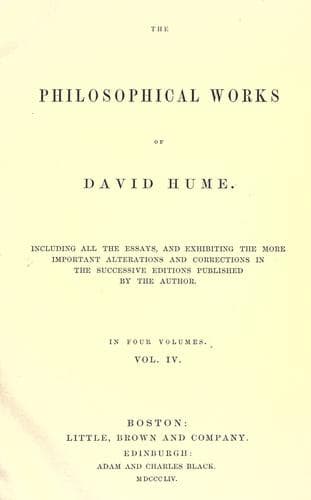
Philosophical Works, v. 1 (of 4): Including All the Essays, and Exhibiting the More Important Alterations and Corrections in the Successive Editions Published by the AuthorHume, David
PhilosophyPhilosophy
Philosophical Works, v. 1 (of 4): Including All the Essays, and Exhibiting the More Important Alterations and Corrections in the Successive Editions Published by the Author
Hume, David
Knowledge, Theory of; Philosophy, English -- 18th century
But farther, what must become of all our particular perceptions upon
this hypothesis? All these are different, and distinguishable, and
separable from each other, and may be separately considered, and may
exist separately, and have no need of any thing to support their
existence. After what manner therefore do they belong to self, and how
are they connected with it? For my part, when I enter most intimately
into what I call _myself_, I always stumble on some particular
perception or other, of heat or cold, light or shade, love or hatred,
pain or pleasure. I never can catch _myself_ at any time without a
perception, and never can observe any thing but the perception. When
my perceptions are removed for any time, as by sound sleep, so long am
I insensible of _myself_, and may truly be said not to exist. And were
all my perceptions removed by death, and could I neither think, nor
feel, nor see, nor love, nor hate, after the dissolution of my body,
I should be entirely annihilated, nor do I conceive what is farther
requisite to make me a perfect nonentity. If any one, upon serious and
unprejudiced reflection, thinks he has a different notion of _himself_,
I must confess I can reason no longer with him. All I can allow him is,
that he may be in the right as well as I, and that we are essentially
different in this particular. He may, perhaps, perceive something
simple and continued, which he calls _himself_; though I am certain
there is no such principle in me.
But setting aside some metaphysicians of this kind, I may venture to
affirm of the rest of mankind, that they are nothing but a bundle or
collection of different perceptions, which succeed each other with an
inconceivable rapidity, and are in a perpetual flux and movement. Our
eyes cannot turn in their sockets without varying our perceptions.
Our thought is still more variable than our sight; and all our
other senses and faculties contribute to this change; nor is there
any single power of the soul, which remains unalterably the same,
perhaps for one moment. The mind is a kind of theatre, where several
perceptions successively make their appearance; pass, repass, glide
away, and mingle in an infinite variety of postures and situations.
There is properly no _simplicity_ in it at one time, nor _identity_
in different, whatever natural propension we may have to imagine that
simplicity and identity. The comparison of the theatre must not mislead
us. They are the successive perceptions only, that constitute the mind;
nor have we the most distant notion of the place where these scenes are
represented, or of the materials of which it is composed.
Public-domain text, read in full here on John Shaqi.
Reviews
Reviews
No reviews yet
Be the first to share your thoughts on this work.
Elsewhere in the archive
Join the Discussion
Join the discussion
Sign in to leave a comment or review.
Sign InorCreate an account