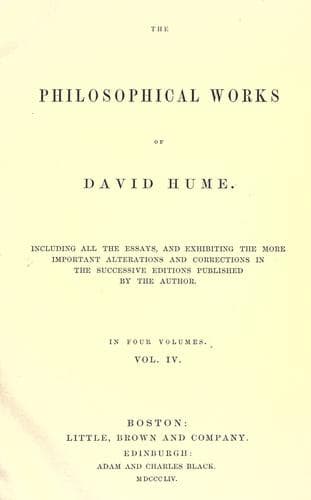
Philosophical Works, v. 1 (of 4): Including All the Essays, and Exhibiting the More Important Alterations and Corrections in the Successive Editions Published by the AuthorHume, David
PhilosophyPhilosophy
Philosophical Works, v. 1 (of 4): Including All the Essays, and Exhibiting the More Important Alterations and Corrections in the Successive Editions Published by the Author
Hume, David
Knowledge, Theory of; Philosophy, English -- 18th century
What then gives us so great a propension to ascribe an identity to
these successive perceptions, and to suppose ourselves possessed of an
invariable and uninterrupted existence through the whole course of our
lives? In order to answer this question, we must distinguish betwixt
personal identity, as it regards our thought or imagination, and as it
regards our passions or the concern we take in ourselves. The first
is our present subject; and to explain it perfectly we must take the
matter pretty deep, and account for that identity, which we attribute
to plants and animals; there being a great analogy betwixt it and the
identity of a self or person.
We have a distinct idea of an object that remains invariable and
uninterrupted through a supposed variation of time; and this idea we
call that of _identity_ or _sameness_. We have also a distinct idea
of several different objects existing in succession, and connected
together by a close relation; and this to an accurate view affords
as perfect a notion of _diversity_, as if there was no manner of
relation among the objects. But though these two ideas of identity,
and a succession of related objects, be in themselves perfectly
distinct, and even contrary, yet 'tis certain that, in our common
way of thinking, they are generally confounded with each other. That
action of the imagination, by which we consider the uninterrupted and
invariable object, and that by which we reflect on the succession of
related objects, are almost the same to the feeling; nor is there much
more effort of thought required in the latter case than in the former.
The relation facilitates the transition of the mind from one object
to another, and renders its passage as smooth as if it contemplated
one continued object. This resemblance is the cause of the confusion
and mistake, and makes us substitute the notion of identity, instead
of that of related objects. However at one instant we may consider
the related succession as variable or interrupted, we are sure the
next to ascribe to it a perfect identity, and regard it as invariable
and uninterrupted. Our propensity to this mistake is so great from
the resemblance above mentioned, that we fall into it before we are
aware; and though we incessantly correct ourselves by reflection,
and return to a more accurate method of thinking, yet we cannot long
sustain our philosophy, or take off this bias from the imagination.
Our last resource is to yield to it, and boldly assert that these
different related objects are in effect the same, however interrupted
and variable. In order to justify to ourselves this absurdity, we often
feign some new and unintelligible principle, that connects the objects
together, and prevents their interruption or variation. Thus, we feign
the continued existence of the perceptions of our senses, to remove
the interruption; and run into the notion of a _soul_, and _self_, and
_substance_, to disguise the variation. But, we may farther observe,
Public-domain text, read in full here on John Shaqi.
Reviews
Reviews
No reviews yet
Be the first to share your thoughts on this work.
Elsewhere in the archive
Join the Discussion
Join the discussion
Sign in to leave a comment or review.
Sign InorCreate an account