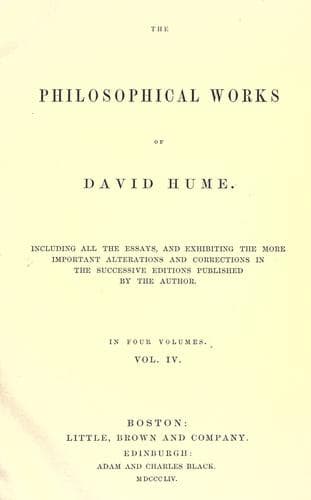
Philosophical Works, v. 1 (of 4): Including All the Essays, and Exhibiting the More Important Alterations and Corrections in the Successive Editions Published by the AuthorHume, David
PhilosophyPhilosophy
Philosophical Works, v. 1 (of 4): Including All the Essays, and Exhibiting the More Important Alterations and Corrections in the Successive Editions Published by the Author
Hume, David
Knowledge, Theory of; Philosophy, English -- 18th century
that where we do not give rise to such a fiction, our propension to
confound identity with relation is so great, that we are apt to imagine
something unknown and mysterious,[16] connecting the parts, beside
their relation; and this I take to be the case with regard to the
identity we ascribe to plants and vegetables. And even when this does
not take place, we still feel a propensity to confound these ideas,
though we are not able fully to satisfy ourselves in that particular,
nor find any thing invariable and uninterrupted to justify our notion
of identity.
Thus, the controversy concerning identity is not merely a dispute
of words. For, when we attribute identity, in an improper sense,
to variable or interrupted objects, our mistake is not confined to
the expression, but is commonly attended with a fiction, either of
something invariable and uninterrupted, or of something mysterious and
inexplicable, or at least with a propensity to such fictions. What
will suffice to prove this hypothesis to the satisfaction of every
fair inquirer, is to show, from daily experience and observation, that
the objects which are variable or interrupted, and yet are supposed
to continue the same, are such only as consist of a succession of
parts, connected together by resemblance, contiguity, or causation.
For as such a succession answers evidently to our notion of diversity,
it can only be by mistake we ascribe to it an identity; and as the
relation of parts, which leads us into this mistake, is really nothing
but a quality, which produces an association of ideas, and an easy
transition of the imagination from one to another, it can only be from
the resemblance, which this act of the mind bears to that by which we
contemplate one continued object, that the error arises. Our chief
business, then, must be to prove, that all objects, to which we ascribe
identity, without observing their invariableness and uninterruptedness,
are such as consist of a succession of related objects.
In order to this, suppose any mass of matter, of which the parts are
contiguous and connected, to be placed before us; 'tis plain we must
attribute a perfect identity to this mass, provided all the parts
continue uninterruptedly and invariably the same, whatever motion or
change of place we may observe either in the whole or in any of the
parts. But supposing some very _small_ or _inconsiderable_ part to
be added to the mass, or subtracted from it; though this absolutely
destroys the identity of the whole, strictly speaking, yet as we seldom
think so accurately, we scruple not to pronounce a mass of matter
the same, where we find so trivial an alteration. The passage of the
thought from the object before the change to the object after it, is so
smooth and easy, that we scarce perceive the transition, and are apt to
imagine, that 'tis nothing but a continued survey of the same object.
Public-domain text, read in full here on John Shaqi.
Reviews
Reviews
No reviews yet
Be the first to share your thoughts on this work.
Elsewhere in the archive
Join the Discussion
Join the discussion
Sign in to leave a comment or review.
Sign InorCreate an account