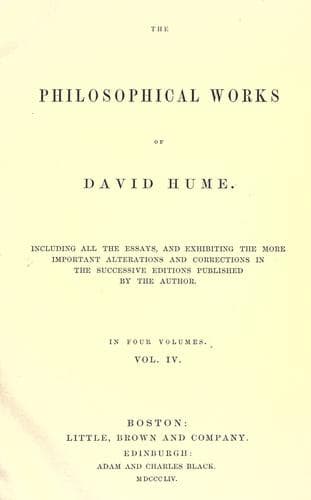
Philosophical Works, v. 1 (of 4): Including All the Essays, and Exhibiting the More Important Alterations and Corrections in the Successive Editions Published by the AuthorHume, David
PhilosophyPhilosophy
Philosophical Works, v. 1 (of 4): Including All the Essays, and Exhibiting the More Important Alterations and Corrections in the Successive Editions Published by the Author
Hume, David
Knowledge, Theory of; Philosophy, English -- 18th century
But this is still more remarkable, when we add a _sympathy_ of parts
to their _common end_, and suppose that they bear to each other the
reciprocal relation of cause and effect in all their actions and
operations. This is the case with all animals and vegetables; where not
only the several parts have a reference to some general purpose, but
also a mutual dependence on, and connexion with, each other. The effect
of so strong a relation is, that though every one must allow, that in
a very few years both vegetables and animals endure a _total_ change,
yet we still attribute identity to them, while their form, size and
substance, are entirely altered. An oak that grows from a small plant
to a large tree is still the same oak, though there be not one particle
of matter or figure of its parts the same. An infant becomes a man, and
is sometimes fat, sometimes lean, without any change in his identity.
We may also consider the two following phenomena, which are remarkable
in their kind. The first is, that though we commonly be able to
distinguish pretty exactly betwixt numerical and specific identity, yet
it sometimes happens that we confound them, and in our thinking and
reasoning employ the one for the other. Thus, a man who hears a noise
that is frequently interrupted and renewed, says it is still the same
noise, though 'tis evident the sounds have only a specific identity or
resemblance, and there is nothing numerically the same but the cause
which produced them. In like manner it may be said, without breach
of the propriety of language, that such a church, which was formerly
of brick, fell to ruin, and that the parish rebuilt the same church
of freestone, and according to modern architecture. Here neither the
form nor materials are the same, nor is there any thing common to the
two objects but their relation to the inhabitants of the parish; and
yet this alone is sufficient to make us denominate them the same. But
we must observe, that in these cases the first object is in a manner
annihilated before the second comes into existence; by which means,
we are never presented, in any one point of time, with the idea of
difference and multiplicity; and for that reason are less scrupulous in
calling them the same.
Public-domain text, read in full here on John Shaqi.
Reviews
Reviews
No reviews yet
Be the first to share your thoughts on this work.
Elsewhere in the archive
Join the Discussion
Join the discussion
Sign in to leave a comment or review.
Sign InorCreate an account