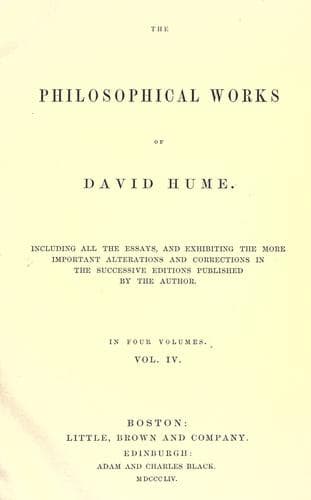
Philosophical Works, v. 1 (of 4): Including All the Essays, and Exhibiting the More Important Alterations and Corrections in the Successive Editions Published by the AuthorHume, David
PhilosophyPhilosophy
Philosophical Works, v. 1 (of 4): Including All the Essays, and Exhibiting the More Important Alterations and Corrections in the Successive Editions Published by the Author
Hume, David
Knowledge, Theory of; Philosophy, English -- 18th century
Secondly, we may remark, that though, in a succession of related
objects, it be in a manner requisite that the change of parts be not
sudden nor entire, in order to preserve the identity, yet where the
objects are in their nature changeable and inconstant, we admit of a
more sudden transition than would otherwise be consistent with that
relation. Thus, as the nature of a river consists in the motion and
change of parts, though in less than four-and-twenty hours these be
totally altered, this hinders not the river from continuing the same
during several ages. What is natural and essential to any thing is,
in a manner, expected; and what is expected makes less impression,
and appears of less moment than what is unusual and extraordinary.
A considerable change of the former kind seems really less to the
imagination than the most trivial alteration of the latter; and by
breaking less the continuity of the thought, has less influence in
destroying the identity.
We now proceed to explain the nature of _personal identity_, which
has become so great a question in philosophy, especially of late
years, in England, where all the abstruser sciences are studied with a
peculiar ardour and application. And here 'tis evident the same method
of reasoning must be continued which has so successfully explained the
identity of plants, and animals, and ships, and houses, and of all the
compounded and changeable productions either of art or nature. The
identity which we ascribe to the mind of man is only a fictitious one,
and of a like kind with that which we ascribe to vegetables and animal
bodies. It cannot therefore have a different origin, but must proceed
from a like operation of the imagination upon like objects.
Public-domain text, read in full here on John Shaqi.
Reviews
Reviews
No reviews yet
Be the first to share your thoughts on this work.
Elsewhere in the archive
Join the Discussion
Join the discussion
Sign in to leave a comment or review.
Sign InorCreate an account