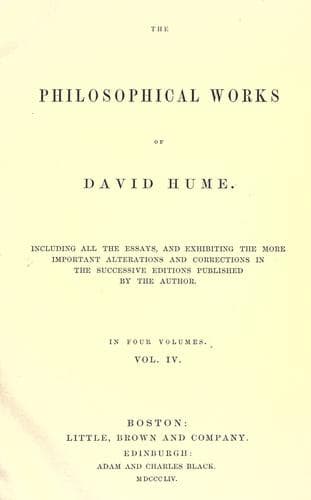
Philosophical Works, v. 1 (of 4): Including All the Essays, and Exhibiting the More Important Alterations and Corrections in the Successive Editions Published by the AuthorHume, David
PhilosophyPhilosophy
Philosophical Works, v. 1 (of 4): Including All the Essays, and Exhibiting the More Important Alterations and Corrections in the Successive Editions Published by the Author
Hume, David
Knowledge, Theory of; Philosophy, English -- 18th century
To begin with _resemblance_; suppose we could see clearly into the
breast of another, and observe that succession of perceptions which
constitutes his mind or thinking principle, and suppose that he always
preserves the memory of a considerable part of past perceptions, 'tis
evident that nothing could more contribute to the bestowing a relation
on this succession amidst all its variations. For what is the memory
but a faculty, by which we raise up the images of past perceptions? And
as an image necessarily resembles its object, must not the frequent
placing of these resembling perceptions in the chain of thought, convey
the imagination more easily from one link to another, and make the
whole seem like the continuance of one object? In this particular,
then, the memory not only discovers the identity, but also contributes
to its production, by producing the relation of resemblance among the
perceptions. The case is the same, whether we consider ourselves or
others.
As to _causation_; we may observe, that the true idea of the human
mind, is to consider it as a system of different perceptions or
different existences, which are linked together by the relation of
cause and effect, and mutually produce, destroy, influence, and
modify each other. Our impressions give rise to their correspondent
ideas; and these ideas, in their turn, produce other impressions. One
thought chases another, and draws after it a third, by which it is
expelled in its turn. In this respect, I cannot compare the soul more
properly to any thing than to a republic or commonwealth, in which
the several members are united by the reciprocal ties of government
and subordination, and give rise to other persons who propagate the
same republic in the incessant changes of its parts. And as the same
individual republic may not only change its members, but also its
laws and constitutions; in like manner the same person may vary his
character and disposition, as well as his impressions and ideas,
without losing his identity. Whatever changes he endures, his several
parts are still connected by the relation of causation. And in this
view our identity with regard to the passions serves to corroborate
that with regard to the imagination, by the making our distant
perceptions influence each other, and by giving us a present concern
for our past or future pains or pleasures.
Public-domain text, read in full here on John Shaqi.
Reviews
Reviews
No reviews yet
Be the first to share your thoughts on this work.
Elsewhere in the archive
Join the Discussion
Join the discussion
Sign in to leave a comment or review.
Sign InorCreate an account