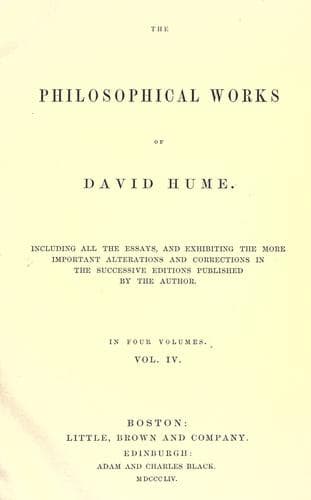
Philosophical Works, v. 1 (of 4): Including All the Essays, and Exhibiting the More Important Alterations and Corrections in the Successive Editions Published by the AuthorHume, David
PhilosophyPhilosophy
Philosophical Works, v. 1 (of 4): Including All the Essays, and Exhibiting the More Important Alterations and Corrections in the Successive Editions Published by the Author
Hume, David
Knowledge, Theory of; Philosophy, English -- 18th century
But lest this argument should not convince the reader, though in my
opinion perfectly decisive, let him weigh the following reasoning,
which is still closer and more immediate. 'Tis evident that the
identity which we attribute to the human mind, however perfect we may
imagine it to be, is not able to run the several different perceptions
into one, and make them lose their characters of distinction and
difference, which are essential to them. 'Tis still true that every
distinct perception which enters into the composition of the mind,
is a distinct existence, and is different, and distinguishable,
and separable from every other perception, either contemporary or
successive. But as, notwithstanding this distinction and separability,
we [suppose] the whole train of perceptions to be united by identity,
a question naturally arises concerning this relation of identity,
whether it be something that really binds our several perceptions
together, or only associates their ideas in the imagination; that is,
in other words, whether, in pronouncing concerning the identity of a
person, we observe some real bond among his perceptions, or only feel
one among the ideas we form of them. This question we might easily
decide, if we would recollect what has been already proved at large,
that the understanding never observes any real connexion among objects,
and that even the union of cause and effect, when strictly examined,
resolves itself into a customary association of ideas. For from thence
it evidently follows, that identity is nothing really belonging to
these different perceptions, and uniting them together, but is merely
a quality which we attribute to them, because of the union of their
ideas in the imagination when we reflect upon them. Now, the only
qualities which can give ideas an union in the imagination, are these
three relations above mentioned. These are the uniting principles in
the ideal world, and without them every distinct object is separable
by the mind, and may be separately considered, and appears not to have
any more connexion with any other object than if disjoined by the
greatest difference and remoteness. 'Tis therefore on some of these
three relations of resemblance, contiguity and causation, that identity
depends; and as the very essence of these relations consists in their
producing an easy transition of ideas, it follows, that our notions of
personal identity proceed entirely from the smooth and uninterrupted
progress of the thought along a train of connected ideas, according to
the principles above explained.
The only question, therefore, which remains is, by what relations this
uninterrupted progress of our thought is produced, when we consider
the successive existence of a mind or thinking person. And here 'tis
evident we must confine ourselves to resemblance and causation, and
must drop contiguity, which has little or no influence in the present
case.
Public-domain text, read in full here on John Shaqi.
Reviews
Reviews
No reviews yet
Be the first to share your thoughts on this work.
Elsewhere in the archive
Join the Discussion
Join the discussion
Sign in to leave a comment or review.
Sign InorCreate an account