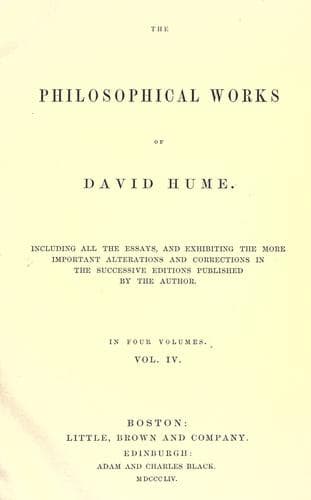
Philosophical Works, v. 1 (of 4): Including All the Essays, and Exhibiting the More Important Alterations and Corrections in the Successive Editions Published by the AuthorHume, David
PhilosophyPhilosophy
Philosophical Works, v. 1 (of 4): Including All the Essays, and Exhibiting the More Important Alterations and Corrections in the Successive Editions Published by the Author
Hume, David
Knowledge, Theory of; Philosophy, English -- 18th century
I imagined, Sir, that my silence, truly interpreted by your
own conscience, had said enough; but since you have some
design in not understanding me, I shall speak. You have
but ill disguised yourself. I know you, and you are not
ignorant of it. Before we had any personal connections,
quarrels, or disputes; while we knew each other only by
literary reputation, you affectionately made me the offer
of the good offices of yourself and friends. Affected by
this generosity, I threw myself into your arms; you brought
me to England, apparently to procure me an asylum, but in
fact to bring me to dishonour. You applied to this noble
work, with a zeal worthy of your heart, and a success
worthy of your abilities. You needed not have taken so much
pains: you live and converse with the world; I with myself
in solitude. The public love to be deceived, and you were
formed to deceive them. I know one man, however, whom you
can not deceive; I mean myself. You know with what horror
my heart rejected the first suspicion of your designs. You
know I embraced you with tears in my eyes, and told you, if
you were not the best of men, you must be the blackest of
mankind. In reflecting on your private conduct, you must
say to yourself sometimes, you are not the best of men:
under which conviction, I doubt much if ever you will be
the happiest.
I leave your friends and you to carry on your schemes as
you please; giving up to you, without regret, my reputation
during life; certain that, sooner or later, justice will be
done to that of both. As to your good offices in matters
of interest, which you have made use of as a mask, I thank
you for them, and shall dispense with profiting by them. I
ought not to hold a correspondence with you any longer, or
to accept of it to my advantage in any affair in which you
are to be the mediator. Adieu, Sir, I wish you the truest
happiness; but as we ought not to have any thing to say to
each other for the future, this is the last letter you will
receive from me.
J. J. R.
To this I immediately sent the following reply.
MR HUME TO MR ROUSSEAU.
_June_ 26_th_, 1766.
Public-domain text, read in full here on John Shaqi.
Reviews
Reviews
No reviews yet
Be the first to share your thoughts on this work.
Join the Discussion
Join the discussion
Sign in to leave a comment or review.
Sign InorCreate an account