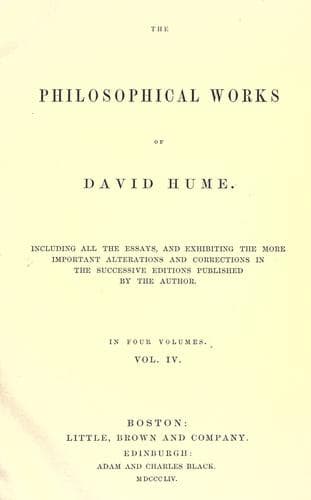
Philosophical Works, v. 1 (of 4): Including All the Essays, and Exhibiting the More Important Alterations and Corrections in the Successive Editions Published by the AuthorHume, David
PhilosophyPhilosophy
Philosophical Works, v. 1 (of 4): Including All the Essays, and Exhibiting the More Important Alterations and Corrections in the Successive Editions Published by the Author
Hume, David
Knowledge, Theory of; Philosophy, English -- 18th century
I was informed that the son of that quack[16] Tronchin,
my most mortal enemy, was not only the friend of Mr Hume,
and under his protection, but that they both lodged in the
same house together; and when Mr Hume found that I knew
it, he imparted it in confidence; assuring me at the same
time that the son was by no means like the father. I lodged
a few nights myself, together with my governante, in the
same house; and by the air and manner with which we were
received by the landladies, who are his friends, I judged
in what manner either Mr Hume, or that man, who, as he
said, was by no means like his father, must have spoken to
them both of her and me.[17]
All these facts put together, added to a certain appearance
of things on the whole, insensibly gave me an uneasiness
which I rejected with horror. In the mean time, I found
the letters I wrote did not come to hand; those I received
had often been opened; and all went through the hands of
Mr Hume.[18] If at any time any one escaped him, he could
not conceal his eagerness to see it. One evening, in
particular, I remember a very remarkable circumstance of
this kind that greatly struck me.[19]
As we were sitting one evening, after supper, silent by
the fire-side, I caught his eyes intently fixed on mine,
as indeed happened very often; and that in a manner of
which it is very difficult to give an idea. At that time
he gave me a stedfast, piercing look, mixed with a sneer,
which greatly disturbed me. To get rid of the embarrassment
I lay under, I endeavoured to look full at him in my
turn; but, in fixing my eyes against his, I felt the most
inexpressible terror, and was obliged soon to turn them
away. The speech and physiognomy of the good David is that
of an honest man; but where, great God! did this good man
borrow those eyes he fixes so sternly and unaccountably on
those of his friends?
Public-domain text, read in full here on John Shaqi.
Reviews
Reviews
No reviews yet
Be the first to share your thoughts on this work.
Join the Discussion
Join the discussion
Sign in to leave a comment or review.
Sign InorCreate an account