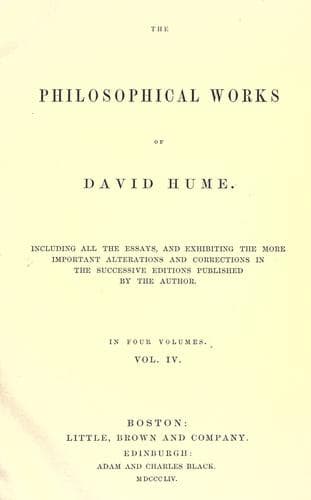
Philosophical Works, v. 1 (of 4): Including All the Essays, and Exhibiting the More Important Alterations and Corrections in the Successive Editions Published by the AuthorHume, David
PhilosophyPhilosophy
Philosophical Works, v. 1 (of 4): Including All the Essays, and Exhibiting the More Important Alterations and Corrections in the Successive Editions Published by the Author
Hume, David
Knowledge, Theory of; Philosophy, English -- 18th century
I have, Sir, so many things to mention, that I forget half
of them by the way. For instance, a certain narrative
in form of a letter, concerning my manner of living at
Montmorency, was given by the booksellers to Mr Hume, who
showed it me. I agreed to its being printed, and Mr Hume
undertook the care of its edition; but it never appeared.
Again, I had brought over with me a copy of the letters
of Mr du Peyron, containing a relation of the treatment I
had met with at Neufchâtel. I gave them into the hands of
the same bookseller to have them translated and reprinted.
Mr Hume charged himself with the care of them; but they
never appeared.[27] The supposititious letter of the King
of Prussia, and its translation, had no sooner made their
appearance, than I immediately apprehended why the other
pieces had been suppressed,[28] and I wrote as much to
the booksellers.[29] I wrote several other letters also,
which probably were handed about London; till at length
I employed the credit of a man of quality and merit, to
insert a declaration of the imposture in the public papers.
In this declaration, I concealed no part of my extreme
concern, nor did I in the least disguise the cause.
Hitherto Mr Hume seems to have walked in darkness. You will
soon see him appear in open day, and act without disguise.
Nothing more is necessary, in our behaviour towards cunning
people, than to act ingenuously; sooner or later they will
infallibly betray themselves.
When this pretended letter from the Ring of Prussia was
first published in London, Mr Hume, who certainly knew that
it was fictitious, as I had told him so, yet said nothing
of the matter, did not write to me, but was totally silent;
and did not even think of making any declaration of the
truth, in favour of his absent friend.[30] It answered his
purpose better to let the report take its course, as he did.
Mr Hume having been my conductor into England, he was of
course in a manner my patron and protector. If it were but
natural in him to undertake my defence, it was no less
so that, when I had a public protestation to make, I
should have addressed myself to him. Having already ceased
writing to him,[31] however, I had no mind to renew our
correspondence. I addressed myself therefore to another
person. The first slap on the face I gave my patron. He
felt nothing of it.
Public-domain text, read in full here on John Shaqi.
Reviews
Reviews
No reviews yet
Be the first to share your thoughts on this work.
Join the Discussion
Join the discussion
Sign in to leave a comment or review.
Sign InorCreate an account