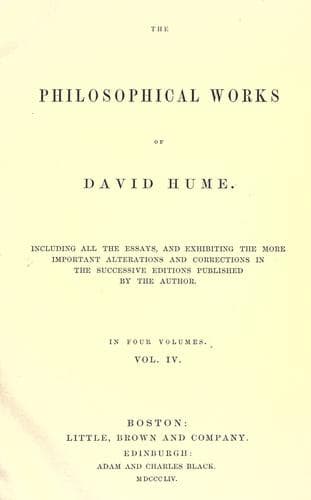
Philosophical Works, v. 1 (of 4): Including All the Essays, and Exhibiting the More Important Alterations and Corrections in the Successive Editions Published by the AuthorHume, David
PhilosophyPhilosophy
Philosophical Works, v. 1 (of 4): Including All the Essays, and Exhibiting the More Important Alterations and Corrections in the Successive Editions Published by the Author
Hume, David
Knowledge, Theory of; Philosophy, English -- 18th century
I did my duty, though not without reluctance. I wrote
immediately to General Conway, and in the most civil and
respectful manner possible, without giving an absolute
refusal, excusing myself from accepting the pension for the
present.
Now, Mr Hume had been the only negociator of this affair,
nay the only person who had spoke of it. Yet I not only
did not give him any answer, though it was he who wrote to
me on the subject, but did not even so much as mention him
in my letter to General Conway. This was the third slap of
the face I gave my patron, which if he does not feel, it is
certainly his own fault, he can feel nothing.
My letter was not clear, nor could it be so to General
Conway, who did not know the motives of my refusal; but
it was very plain to Mr Hume, who knew them but too well.
He pretended nevertheless to be deceived as well with
regard to the cause of my discontent, as to that of my
declining the pension; and, in a letter he wrote me on the
occasion, gave me to understand that the King's goodness
might be continued towards me, if I should reconsider the
affair of the pension. In a word, he seemed determined,
at all events, to remain still my patron, in spite of my
teeth. You will imagine, Sir, he did not expect my answer;
and he had none. Much about this time, for I do not know
exactly the date, nor is such precision necessary, appeared
a letter, from Mr de Voltaire to me, with an English
translation, which still improved on the original. The
noble object of this ingenious performance, was to draw
on me the hatred and contempt of the people, among whom
I was come to reside. I made not the least doubt that my
dear patron was one of the instruments of its publication;
particularly when I saw that the writer, in endeavouring
to alienate from me those who might render my life
agreeable, had omitted the name of him who brought me over.
He doubtless knew that it was superfluous, and that with
regard to him, nothing more was necessary to be said. The
omission of his name, so impoliticly forgot in this letter,
recalled to my mind what Tacitus says of the picture of
Brutus, omitted in a funeral solemnity, viz. that every
body took notice of it, particularly because it was not
there.
Public-domain text, read in full here on John Shaqi.
Reviews
Reviews
No reviews yet
Be the first to share your thoughts on this work.
Join the Discussion
Join the discussion
Sign in to leave a comment or review.
Sign InorCreate an account